Digital vs Printed Wedding Cards in Nepal: Cost, Etiquette and What Families Prefer
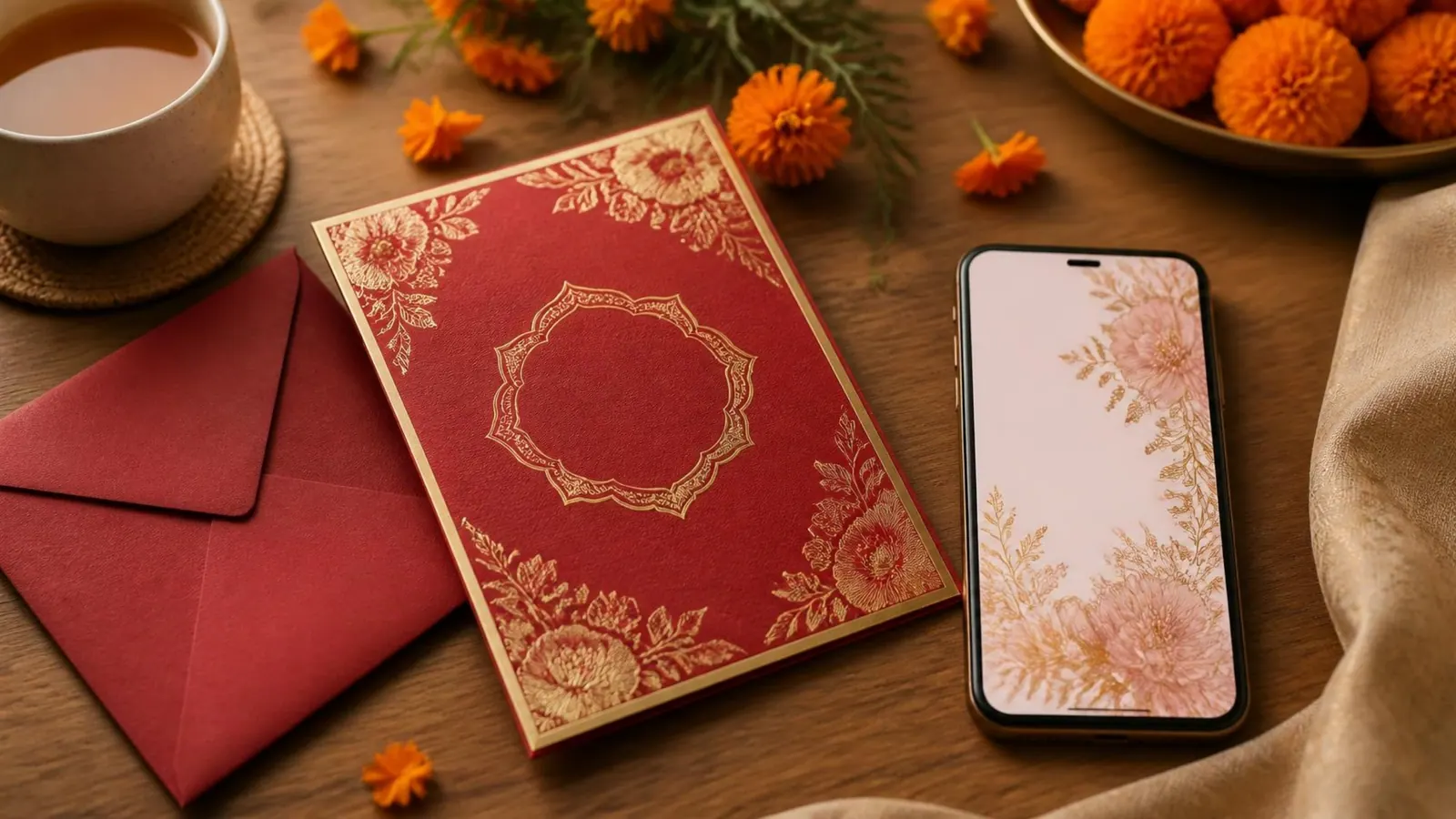
An honest look at printed cards and online invitations for a Nepali wedding: what each really costs, what elders expect, and how to send a link without seeming careless.

For most Nepali weddings today, the best answer is not one or the other. The digital wedding card Nepal couples now send on WhatsApp is cheaper per guest, reaches relatives abroad on the same day, and collects RSVPs for you. A printed card still carries weight with elders, who often expect a card in hand or a personal visit.
So many families now do both. They print a small number of cards for grandparents and senior relatives, and send a link to everyone else. This guide compares the two honestly, explains what really drives the cost, and gives you messages you can copy.
E-Card vs Printed Card: The Quick Comparison
Here is how the two options compare on the things families ask about most.
| Point | Printed card | Digital wedding card |
|---|---|---|
| Main cost drivers | Paper, printing method, foil or embossing, boxes, quantity, extra prints, delivery trips | One fixed price for the design and setup; no cost per guest |
| Time to prepare | Design, proof, print run, then days of distribution | Usually 1 to 3 business days of design help, then sent in minutes |
| Reach abroad | Post or courier, slow and costly | Same day, any country, through WhatsApp, Viber or email |
| RSVP | Phone calls and memory | Guests reply on the invitation; you see a list |
| Changes after sending | Reprint, or call everyone | Update once; the same link shows the new details |
| Every ceremony and map | Limited by card size | Each event with time, venue and a Google Maps link |
| Keepsake value | High; it can go in an album | Lower; it lives on a phone |
| How elders feel | Familiar and respectful | Fine for many, if you also call |
Neither option wins every row. That is why the mixed approach, covered below, is so common.
Printed Wedding Card Price in Nepal: What Drives the Cost
You will not find one fixed printed wedding card price in Nepal, because every order is different. One Nepali wedding directory, Bihebazaar, says card prices start from about Rs 50 per card and can go to Rs 500 or more. It names design, printing technique, paper quality and the number of cards as the main factors.
Treat that as a rough range, not a quote. Prices change every season, so ask two or three printers for a written quote on the same specification.
Paper, print and finish
Paper is the first big choice. The Kathmandu Post reported that many Nepali families prefer cards made of traditional lokta paper. Handmade paper, velvet or thick card stock all cost more than plain art paper.
Finishes add to the price. Gold foil, embossing, laser cuts, ribbons and wax seals each add a step at the press. Kathmandu Print Shop says its pricing depends on paper type, printing method, finishing and quantity.
Quantity, boxes and extras
Quantity cuts both ways. A bigger order usually lowers the price of each card, but the total bill grows. Many families also need more than one card. The same Kathmandu Post feature quoted a card designer who said a single client often orders cards for five different ceremonies.
Then come the extras that are easy to forget:
- Boxes or envelopes, and sweets or dry fruit packed with the card
- Extra prints when the guest list grows late
- A reprint if a name, date or time is wrong
- Separate cards for the reception or bhoj
The hidden cost: distribution
The cost that rarely appears on a quote is handing the cards out. In the Kathmandu Valley, that can mean many evenings of driving or riding across the city, plus fuel, plus time away from work. Some families send younger relatives with stacks of cards for a whole week.
For relatives abroad, posting a card is slow and courier fees add up quickly. Many families end up sending those relatives a photo of the card on WhatsApp, which is already a digital invitation in all but name.
What a Digital Wedding Card in Nepal Costs
A digital invitation has a different cost shape. You pay for the design and setup once. After that, sending it to 50 guests or 800 guests costs the same.
At Nimtto, for example, the prices on the pricing page are fixed and paid once, with no subscription and no charge per guest:
- Standard, Rs 2,999: a ready-made design with names, date, venue, RSVP and a WhatsApp link
- Pro, Rs 4,999: adds photos and your story, every ceremony with maps, music and the opening scene
- Pro Max, Rs 6,999: adds premium designs, personal guest links and priority help until the wedding
- Custom, from Rs 11,111: a design made for your occasion
Other digital options exist too, from free templates to video cards. The cheapest ones are often a single image, which works but cannot show every event, collect replies or be updated later. Compare what you get, not only the price.
Wedding Card Etiquette in Nepal: What Elders Expect
This is the part that worries most families, and for good reason. Wedding card etiquette in Nepal has always been about respect as much as information.
Handing over a card in person is a sign of respect. The Bihebazaar guide notes that people still want to distribute cards the traditional way because it seems respectful to guests and is part of the culture. The Kathmandu Post put it simply: social media brought the e-vite, but many in Kathmandu still prefer the traditional invite.
In practice, many families follow a few common patterns:
- Senior relatives (grandparents, elder uncles and aunts, the family's older generation) often expect a visit or at least a phone call.
- Close family usually hears the news in person or by phone long before any card arrives.
- Friends, colleagues and neighbours are generally comfortable with a WhatsApp or Viber invitation, especially younger guests.
- Relatives abroad cannot receive a card by hand anyway, so a digital invitation is often the most practical way to include them properly.
Customs vary by family, community and region. A family in Kathmandu may feel very different from a family in a smaller town. If you are unsure, ask the eldest person in your family how they would like each household to be invited.
What Families Prefer (and Why It Varies)
There is no reliable survey of Nepali families on this question, so be wary of anyone who quotes a percentage. What we can describe are patterns that come up again and again when families plan.
Families with many relatives abroad tend to lean digital. A link reaches Sydney, Doha and Texas on the same day, and those guests can see every event, the venue map and the dates in one place.
Families with very senior relatives, or close ties to a village or a traditional community, tend to keep printed cards for those households. The card is part of the visit, and the visit is the real invitation.
Younger couples who plan their own wedding often push for digital to save time. Their parents may want printed cards. The mixed approach usually settles this kindly, because both sides get what matters to them.
Cards have also grown more elaborate over the years. As far back as 2005, a Nepali Times columnist wrote about invitations getting gaudier and bigger, with several cards for different parties of the same couple. For some families, a digital invitation is a relief from that race.
The Mixed Approach: A Small Print Run Plus a Link
This is the plan many families settle on, and it works well.
- Make the digital invitation first. Put in every ceremony, time, venue and map. Check the names and dates with the designer before anyone sees it.
- List the households who need a card in hand. Grandparents, senior relatives, family gurus, and anyone without a smartphone.
- Print a small, good run for that list. Since you need fewer cards, you can choose better paper or a nicer finish for the same budget.
- Add a QR code or short link on the printed card. Elders' children and grandchildren can open it for the map and the full programme.
- Send the link to everyone else with a personal message, and call the people who matter most.
The printed card does the respectful work. The digital one does the practical work: maps, timings, replies and last-minute changes.

How to Send an Online Wedding Invitation in Nepal Respectfully
An online wedding invitation in Nepal is judged by how you send it. A few habits make all the difference.
- Send it to each person or household, not to a big group.
- Use their name and the relation you call them by (Thulobuwa, Maiju, Didi).
- Write one or two lines in your own words.
- Call elders before or after you send the link.
- Ask relatives who are close to an elder to help them open it.
If you need full invitation text, our guide to wedding invitation wording in Nepali and English has formal and family versions. The messages below are what you send with the link.
आदरणीय [नाम] हजुर,
नमस्कार। हाम्रो [छोरा/छोरी] [नाम] को शुभ विवाह [मिति] मा [स्थान] मा हुँदैछ।
यस शुभ अवसरमा हजुरको उपस्थिति र आशीर्वादको हामी हार्दिक अपेक्षा गर्दछौं।
सबै कार्यक्रमको समय र नक्सा यो लिङ्कमा छ: [link]
म चाँडै हजुरलाई फोन पनि गर्नेछु।
[तपाईंको नाम] र परिवारHi [Name]! We are getting married on [date] at [venue] and we would love to have you there. All the events, times and maps are here: [link] Please tap RSVP by [date] so we can plan food and seating. See you soon, [Your names]
Namaste [Thulobuwa / Maiju / title], ma [your name] boldai chhu.
[Name] ko bibaha [date] ma pakka bhayo, hajurlai nimto dina phone gareko.
Hajur aaunu bhayo bhane hamilai thulo aashirbad hunchha.
Sabai bibaran hajurko phone ma pathaidinchhu, ra [day] ma card liyera aaunchhu.

(In English: Namaste, this is [your name]. [Name]'s wedding is fixed for [date], and I am calling to invite you. Your presence would be a great blessing for us. I will send all the details to your phone, and I will bring the card on [day].)
Dear [Name],
[Bride's name] and [Groom's name] are getting married in [city] on [date in BS] ([date in AD]).
We know travelling home is not easy, but you are in our hearts for this day.
The full programme, venue maps and photos are here: [link]
If you can come, please RSVP by [date]. If not, we will feel your blessings from afar.
With love,
[Your names] and family
सबै कार्यक्रमको समय, स्थान र नक्साका लागि यो QR कोड स्क्यान गर्नुहोस्।
Scan for every ceremony, venue map and RSVP.
[short link]
For families with many guests overseas, our guide to inviting relatives abroad to a Nepali wedding covers timing and time zones in more detail. The families abroad page explains how Nimtto works when the couple or the family lives overseas.
Mistakes to Avoid With Either Option
Most invitation problems come from rushing. These are the ones families mention most often.
- Forwarding one image to a big group. It feels careless, and people may miss it in a busy chat.
- Forgetting the BS and AD dates. Many elders think in Bikram Sambat. Show both.
- Skipping the call to elders. A link without a call can feel cold to the older generation.
- Printing before the details are final. A wrong time on 300 cards is an expensive mistake. Finalise the digital version first, then print.
- Leaving out maps. Guests from outside the city, and drivers, need a clear venue pin for each event.
- No RSVP date. Without one, you will be counting guests by phone in the last week.
Choosing What Fits Your Family
Start with your guest list, not with the card. Mark the households who need a visit, the ones who need a call, and the ones who will be happy with a message. That list tells you how many cards to print and who gets a link.
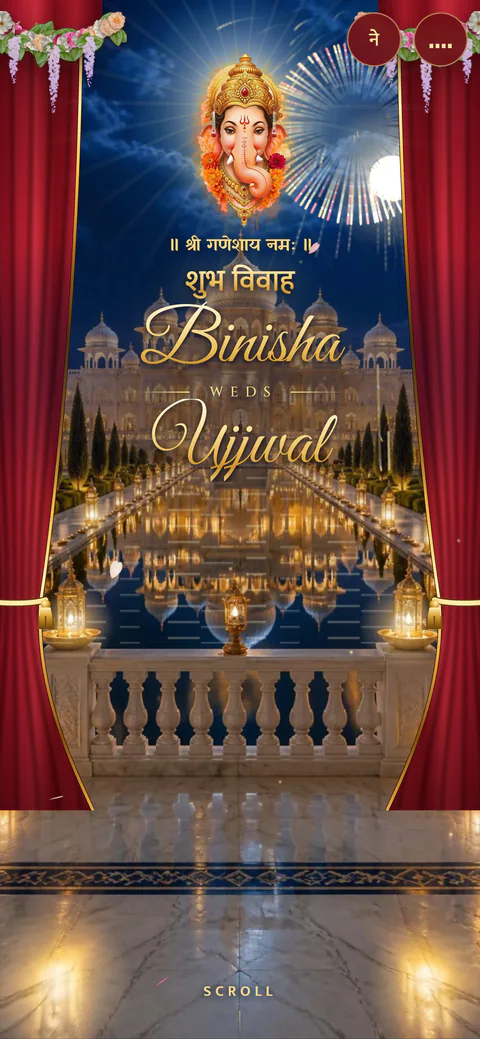
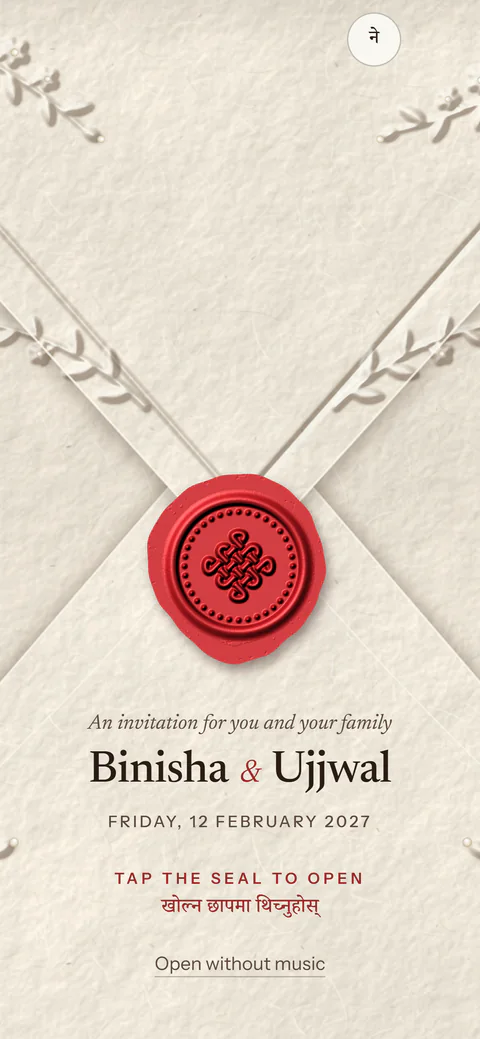
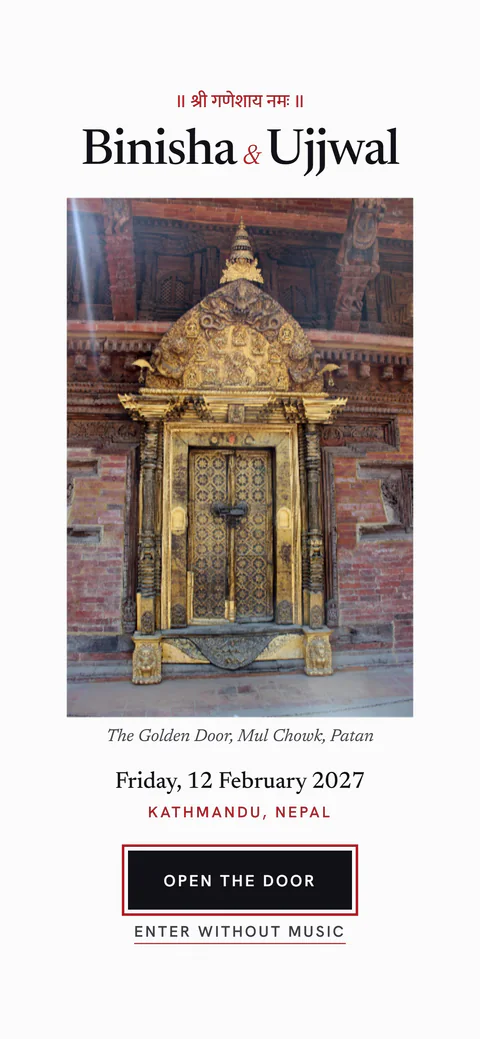
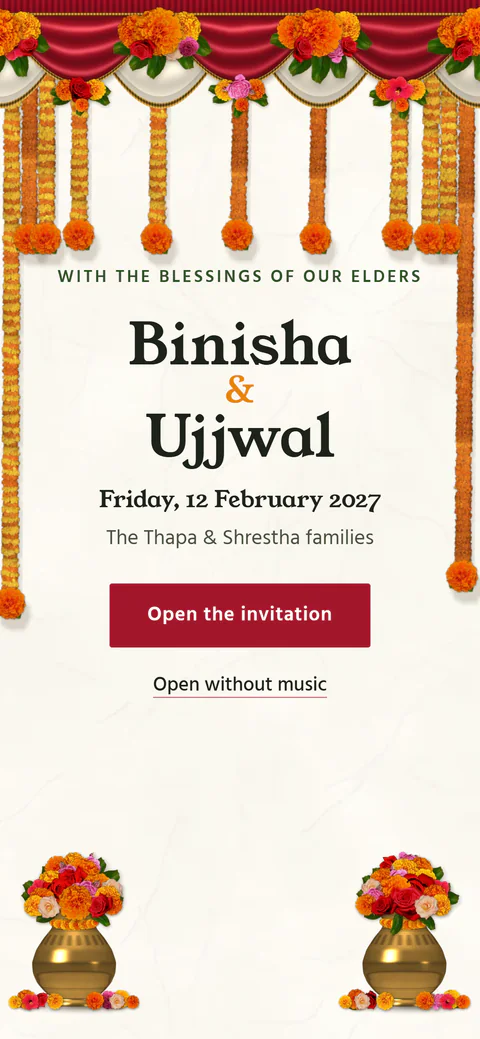
If you choose to go digital for most guests, take a look at the Nimtto designs for Nepali weddings, such as the Kham envelope with its red wax seal or the golden Patan door of Dhoka. The wedding invitation card online page shows what a full invitation includes, and the pricing page lists every plan.
Questions people ask
Is it rude to send a wedding invitation on WhatsApp in Nepal?
Not if you make it personal. Write the guest's name, add a warm line in your own words, and call your elders as well. What feels rude is a forwarded link with no greeting, sent to a big group.
How many printed cards should we order if we also send a digital invitation?
Count the households who truly need a card in hand: grandparents, senior relatives, family priests or gurus, and anyone who does not use a smartphone. Add a few spares for people you forgot. Many families find this is a small share of the full guest list.
How early should we send a digital wedding card in Nepal?
Send it about the same time you would hand out cards, usually a few weeks before the first ceremony. Relatives abroad need more notice, so tell them the date as soon as it is fixed, then send the full invitation later.
Can a digital invitation show the date in Bikram Sambat?
Yes. A good Nepali digital invitation shows the date in BS and AD together. Nimtto invitations on the Nepal site do this, and the text can be in Nepali, English or both. See the features page.
Can we change the venue or time after sending a digital invitation?
Yes, and this is one of its biggest advantages. You update the invitation and the same link shows the new details. Still send a short message to guests so they notice the change.
Do guests need to download an app to open an online wedding invitation?
Not with Nimtto. Guests tap one link in WhatsApp, Viber, email or SMS and it opens in their phone's browser. There is no account to make. Read how it works.
Is a printed card still worth it as a keepsake?
For many families, yes. A printed card can sit in a photo album for decades. If keepsake value matters to you, print a small number of good cards for close family rather than a large number of cheap ones.