Wedding Invitation Wording in Nepali and English (Copy-Ready Examples)
Copy-ready Nepali and English wording for a wedding card, from the invocation line to the RSVP, plus short messages to send with your invitation link.

The usual wedding invitation wording in Nepali follows a fixed order: an invocation such as ॥ श्री गणेशाय नमः ॥, the heading शुभ विवाह, the parents' names, the couple's names, the ceremony dates in Bikram Sambat, the venue, and a closing line from the family (दर्शनाभिलाषी or निवेदक, followed by सपरिवार). Keep the honorifics the same from start to finish and write the BS date first, with AD in brackets.
Below you will find a table of that structure and more than a dozen copy-ready blocks: formal Nepali from the bride's side and the groom's side, English and bilingual versions, a bhoj-only card, RSVP and blessings lines, and short WhatsApp messages. Change the names in square brackets and they are ready to use.
How a Nepali wedding card is structured
Most Nepali wedding card matter, printed or online, moves from the sacred to the practical. The invocation and heading come first, then the families, then the plans, then the people who invite you. If you keep that order, elders will find the card proper and younger guests will find what they need.
| Part | Nepali term | What goes in it | Tip |
|---|---|---|---|
| Invocation | मङ्गलाचरण | ॥ श्री गणेशाय नमः ॥ or a short verse your family uses | Ask elders which line your family prefers |
| Heading | शुभ विवाह | The words "Shubha Bibaha" (auspicious wedding) | Often in a larger, decorative script |
| Hosts | आमाबुबा | The parents who send the card | Use श्रीमान् and श्रीमती consistently |
| The couple | सुपुत्र / सुपुत्री | Groom and bride, each with their parents' names | Spell names the way the couple writes them |
| Ceremonies | कार्यक्रम | Each rite with date, time and venue | One line per event is easiest to read |
| Feast | प्रीतिभोज / स्वागत समारोह | Dinner or reception time and place | Say "onwards" if there is no end time |
| Request | अनुरोध | The polite request to attend and bless the couple | सपरिवार invites the whole household |
| Signature | दर्शनाभिलाषी / निवेदक | Grandparents, parents, siblings, "and family" | Seniors first |
| RSVP and contact | सम्पर्क | One or two phone numbers, a reply date | A named person, not just a number |
On an online invitation the same order still works. The difference is that each ceremony can carry its own map link, and guests reply on the page instead of calling you.
Formal wedding invitation wording in Nepali
These blocks use हजुर and honorific verbs (उपस्थित भई, दिनुहुन) all the way through. That is the safest tone for a card that goes to grandparents, teachers and family elders. If your family normally writes तपाईं, change every instance, not only the first.
From the bride's family (कन्या पक्ष)
॥ श्री गणेशाय नमः ॥

शुभ विवाह

श्रीमान् [बुबाको नाम] तथा श्रीमती [आमाको नाम]की सुपुत्री
[दुलहीको नाम]
र
श्रीमान् [दुलहाका बुबाको नाम] तथा श्रीमती [दुलहाकी आमाको नाम]का सुपुत्र
चि. [दुलहाको नाम]

को शुभ विवाह मिति २०८३ साल फागुन १२ गते बुधबार हुने भएकाले उक्त शुभ अवसरमा हजुर सपरिवार उपस्थित भई नवदम्पतीलाई शुभ आशीर्वाद दिनुहुन हार्दिक अनुरोध गर्दछौं।

कार्यक्रम
जन्ती स्वागत: बेलुका ४:०० बजे
विवाह संस्कार: बेलुका ५:०० बजे
प्रीतिभोज: बेलुका ७:०० बजेदेखि

स्थान: [भेन्यूको नाम], [ठेगाना]

दर्शनाभिलाषी
[हजुरबुबा तथा हजुरआमाको नाम]
[बुबा तथा आमाको नाम] सपरिवार
सम्पर्क: [फोन नम्बर]
From the groom's family: the janti invitation (वर पक्ष)
The groom's side invites guests to walk with the janti (the wedding party) to the bride's home or venue. Say clearly where the janti leaves from and at what time, because that is the detail people forget.
॥ श्री गणेशाय नमः ॥

शुभ विवाह

हाम्रा सुपुत्र चि. [दुलहाको नाम]
र
श्रीमान् [दुलहीका बुबाको नाम] तथा श्रीमती [दुलहीकी आमाको नाम]की सुपुत्री
[दुलहीको नाम]

को शुभ विवाह मिति २०८३ साल फागुन १२ गते बुधबार हुने भएकाले सोही दिन दिउँसो २:०० बजे [घरको ठेगाना]बाट प्रस्थान हुने जन्तीमा सामेल भई तथा बेलुका ७:०० बजेदेखि हुने प्रीतिभोजमा सपरिवार उपस्थित भई नवदम्पतीलाई आशीर्वाद दिनुहुन हार्दिक अनुरोध गर्दछौं।

जन्ती प्रस्थान: [घरको ठेगाना], दिउँसो २:०० बजे
विवाह स्थल: [भेन्यूको नाम], [ठेगाना]

निवेदक
[बुबा तथा आमाको नाम] सपरिवार
सम्पर्क: [फोन नम्बर]
A shorter, warmer Nepali version
Some families want a simple biha ko nimto for friends and colleagues, without the full formal frame. This one is still polite but reads like a personal note.
शुभ विवाह

हाम्रो छोरी [दुलहीको नाम] र [दुलहाको नाम]को विवाह २०८३ फागुन १२ गते बुधबार हुँदै छ।

यो खुसीको दिनमा हजुरको उपस्थिति र आशीर्वाद पाउँदा हामीलाई निकै खुसी लाग्नेछ।

स्थान: [भेन्यूको नाम], [ठेगाना]
प्रीतिभोज: बेलुका ७:०० बजेदेखि

[बुबा तथा आमाको नाम] परिवारWedding card wording in English for Nepal
English cards in Nepal tend to follow the South Asian style: the parents host, the programme is listed, and the card ends with "With best compliments from" and the family. That differs a little from American etiquette, where the hosts' line opens the card and gifts are never mentioned.
In American etiquette, Emily Post's guide to formal invitations keeps "the honour of your presence" for a ceremony in a house of worship and "the pleasure of your company" for other venues. On a Nepali card in English, either reads well, so choose the one your family likes.
Shubha Bibaha

Mr [Father's name] and Mrs [Mother's name] [Surname]
request the honour of your presence with family
at the wedding of their daughter
[Bride's name]
with
[Groom's name]
son of Mr [Father's name] and Mrs [Mother's name] [Surname]

Wednesday, 24 February 2027
(Falgun 12, 2083 B.S.)

Programme
Welcoming the janti: 4:00 pm
Wedding rites: 5:00 pm
Dinner: 7:00 pm onwards

Venue: [Venue name], [Address]

With best compliments from
[Grandparents' names] and family
Contact: [Phone number]
Shubha Bibaha

Mr and Mrs [Groom's parents' names]
warmly invite you and your family
to join the janti for the wedding of their son
[Groom's name]
with
[Bride's name]
daughter of Mr and Mrs [Bride's parents' names]

Wednesday, 24 February 2027 (Falgun 12, 2083 B.S.)

Janti departs: 2:00 pm from [Home address]
Wedding venue: [Venue name], [Address]
Dinner: 7:00 pm onwards

With love from
[Parents' names] and family
Together with our families
[Bride's name] and [Groom's name]
invite you to celebrate our wedding

Wednesday, 24 February 2027
Falgun 12, 2083 B.S.
[Venue name], [City]

Wedding rites at 5:00 pm, dinner from 7:00 pm.
Your blessings mean the world to us.
Bilingual shubha bibaha invitation wording
A bilingual card helps when one side of the family reads Nepali and the other, or relatives abroad, read English more easily. Put each Nepali line directly above its English line so readers never lose their place.
॥ श्री गणेशाय नमः ॥
शुभ विवाह | Shubha Bibaha

[बुबा तथा आमाको नाम]की सुपुत्री [दुलहीको नाम]
[Bride's name], daughter of [Parents' names]
र | with
[बुबा तथा आमाको नाम]का सुपुत्र चि. [दुलहाको नाम]
[Groom's name], son of [Parents' names]

२०८३ साल फागुन १२ गते बुधबार
Wednesday, 24 February 2027

हजुर सपरिवार उपस्थित भई नवदम्पतीलाई आशीर्वाद दिनुहुन हार्दिक अनुरोध गर्दछौं।
We warmly invite you and your family to bless the couple.

स्थान | Venue: [Venue name], [Address]
दर्शनाभिलाषी | With best compliments: [Family name] परिवार | family
On paper, two languages take double the space. Online, you can skip that trade-off: Nimtto invitations show Nepali and English versions of the same page, and each guest taps the language they prefer.
Writing the date in Bikram Sambat and AD
Bikram Sambat is Nepal's official calendar, and its year runs about 56 or 57 years ahead of AD depending on the month, as the Vikram Samvat entry on Wikipedia explains. Always fix the date with your priest's patro first, then convert it.
Wedding dates (sait) are worked out from the panchanga, and only some days in a season suit a wedding. Onlinekhabar's report on the wedding season explains that astrologers and the Nepal Panchanga Nirnayak Samiti set these days, which is why venues book out fast. Print the date only after the venue confirms.
मिति: वि.सं. २०८३ साल फागुन १२ गते, बुधबार
(तदनुसार सन् २०२७ फेब्रुअरी २४)Wednesday, 24 February 2027 (Falgun 12, 2083 B.S.)
Reception and bhoj only
Many families send a separate card for the reception or bhoj, often to office colleagues and neighbours who will not attend the rites. Keep it short, and say "onwards" when guests can come at any time in the evening. Our reception and bhoj page shows how an online version looks.
हाम्रा सुपुत्र चि. [दुलहाको नाम] र बुहारी [दुलहीको नाम]को शुभ विवाहको उपलक्ष्यमा मिति २०८३ फागुन १४ गते शुक्रबार बेलुका ६:०० बजेदेखि [भेन्यूको नाम]मा आयोजना गरिएको प्रीतिभोजमा हजुर सपरिवार उपस्थित भइदिनुहुन हार्दिक अनुरोध गर्दछौं।

निवेदक
[बुबा तथा आमाको नाम] सपरिवारMr and Mrs [Parents' names] invite you and your family to a reception to celebrate the wedding of [Groom's name] and [Bride's name] Friday, 26 February 2027 (Falgun 14, 2083 B.S.) 6:00 pm onwards [Venue name], [Address]
RSVP and blessings lines
An RSVP line is newer on Nepali cards, but it saves the caterer guessing. Give one date and one way to reply.
कृपया [मिति]भित्र आउने वा नआउने जानकारी गराइदिनुहुन अनुरोध छ।
Kindly let us know by [date] if you can join us.
Gifts are trickier. Emily Post advises leaving gifts off the invitation entirely, even "no gifts, please". The Knot suggests putting gift notes on the wedding website instead. If you still want to say it, keep it to one gentle line about blessings, in a notes section rather than on the front of the card.
हजुरको उपस्थिति र आशीर्वाद नै हाम्रा लागि सबैभन्दा ठूलो उपहार हो।
Your presence and blessings are the only gift we wish for.
WhatsApp messages to send with your invitation link
A link arrives better with a short personal note. Use the guest's name, say who is getting married, and tell them where to reply.
नमस्ते [नाम] ज्यू,
हाम्रो छोरी [दुलहीको नाम]को शुभ विवाहको निम्तो यस लिंकमा पठाएका छौं: [लिंक]
कार्यक्रम, समय र नक्सा सबै लिंकमै छन्। कृपया लिंकमै आउने जानकारी दिनुहोला।
[नाम] परिवारNamaste [Name], We would love you to join us for [Bride's name] and [Groom's name]'s wedding. Our invitation is here: [link] Every ceremony, time and map is on the page. Please reply on the invitation by [date]. With love, [Name] family
For relatives in other time zones, add the local time or ask them to check the date twice. Our guide to inviting relatives abroad to a Nepal wedding covers that in detail, and the families abroad page shows how they can reply from anywhere.
Mistakes to check before you send
A quick read for these slips will save reprints and awkward calls.
- Mixed honorifics. हजुर in the request and तपाईं in the RSVP line sounds careless. Pick one.
- Names that do not match. Spell each parent's name the way they sign it, in both scripts.
- Missing janti time. The groom's side must say where and when the janti leaves.
- Only one calendar. Older relatives look for BS, younger ones and guests abroad look for AD. Give both.
- No contact person. Write a name next to the phone number.
- Too many ceremonies on one card. If you also host a maagni or mehendi, list it separately or link to an engagement invitation.
If you are still deciding between paper and a link, our comparison of digital and printed wedding cards in Nepal lays out the costs and the trade-offs.
Putting your wording on an invitation
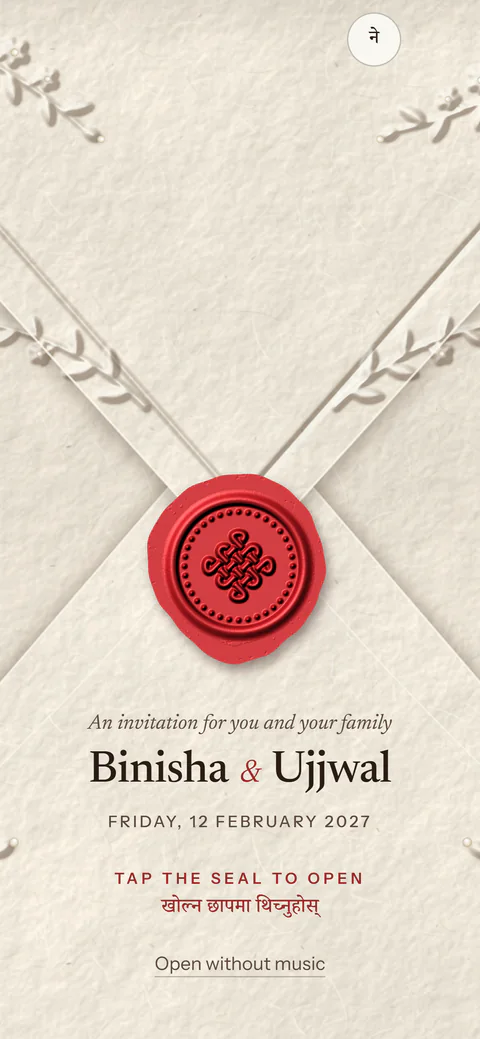
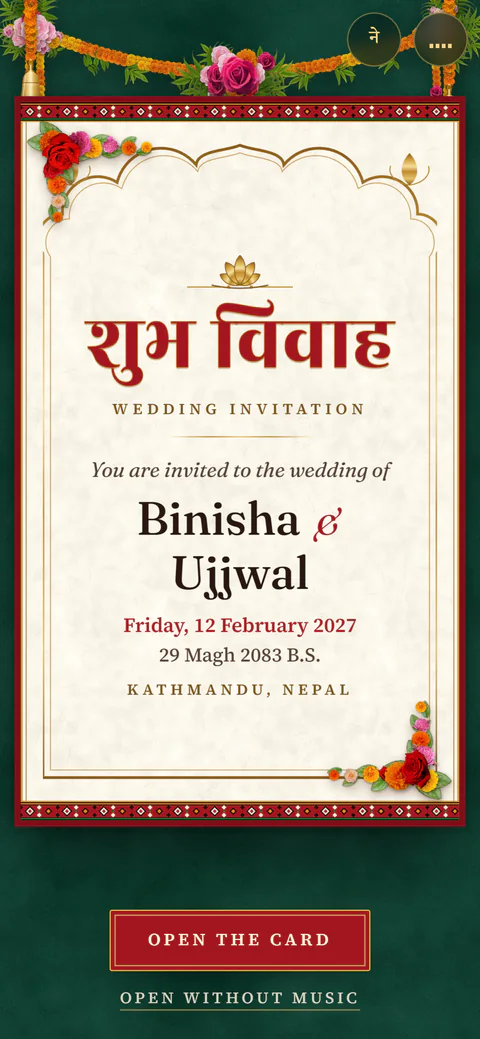
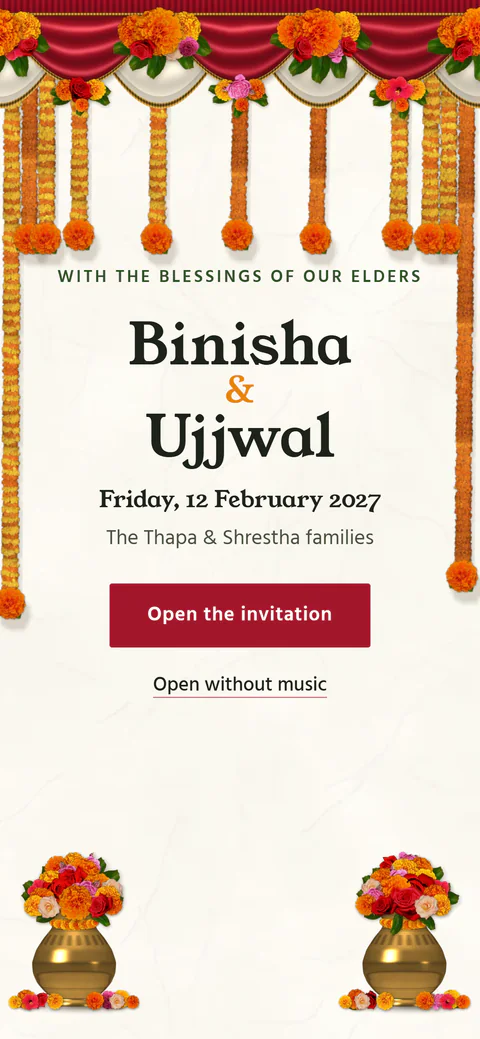
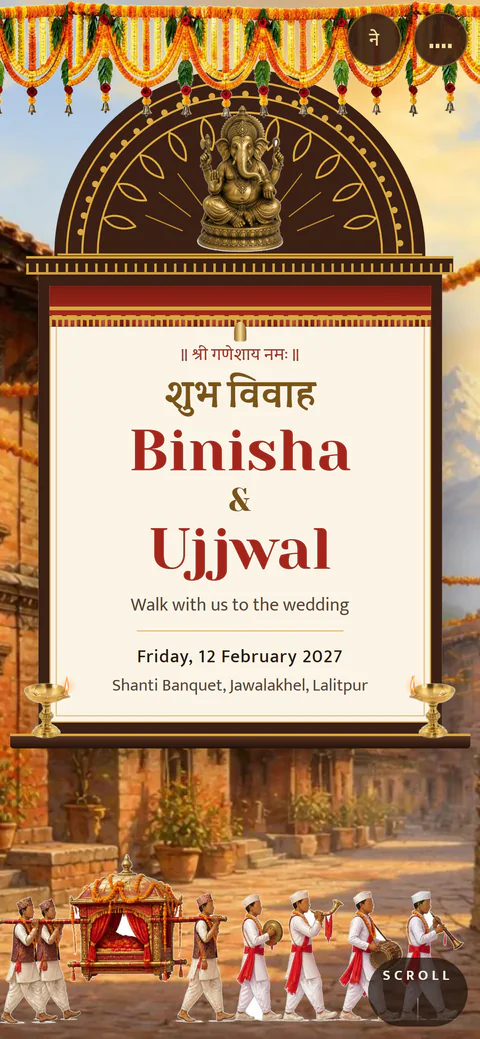
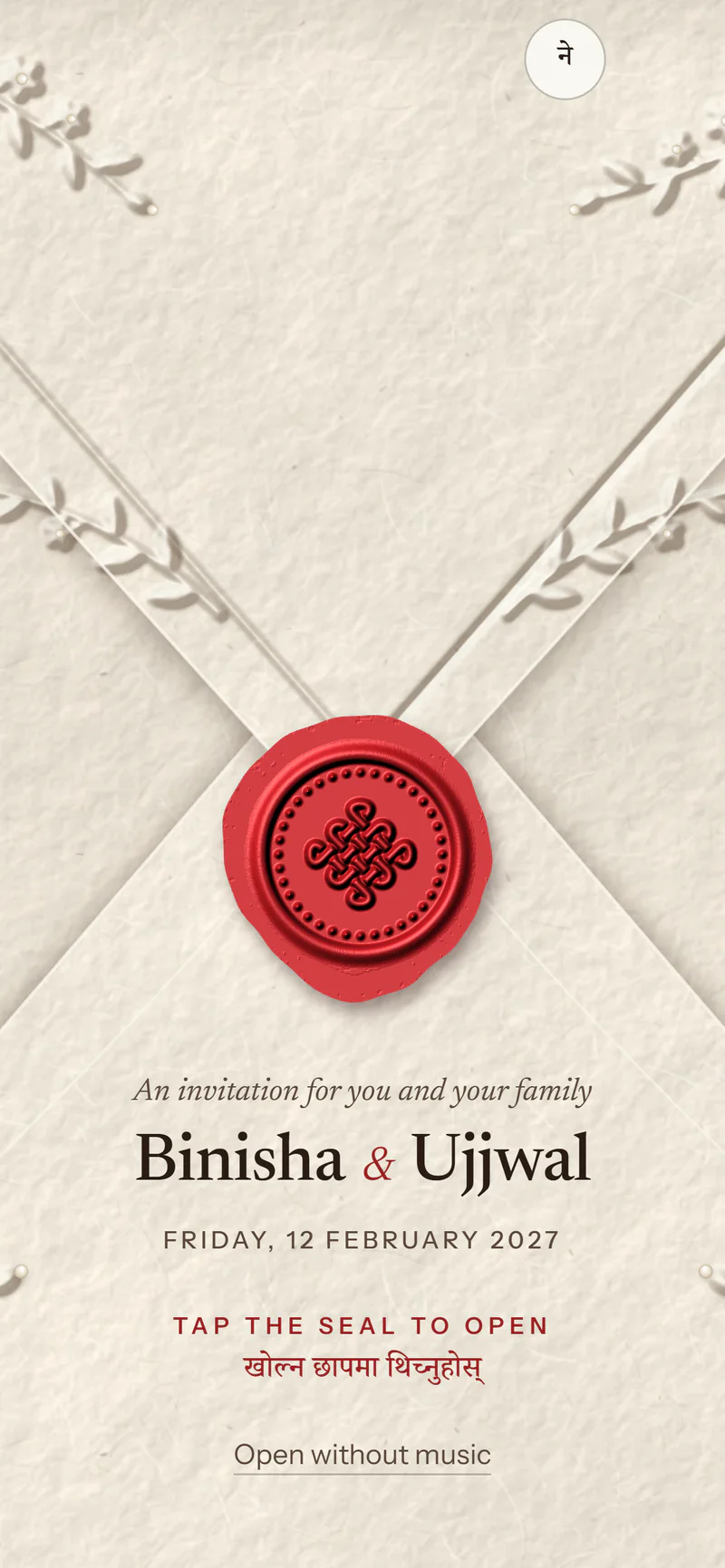
Once your wedding invitation wording in Nepali and English is ready, you can print it, send it as an image, or put it on an online invitation. The Kham design opens like an envelope with a red wax seal, Nimantrana unfolds as a red and gold card, and Mala uses red silk, marigolds and a kalash.
With Nimtto, a designer sets up your wording in Nepali and English, lists every ceremony with a map, and collects RSVPs in one place. Browse the wedding invitation designs, see how it works, or compare plans on the pricing page when you are ready.
Questions people ask
Who should be named as the host on a Nepali wedding card?
Usually the parents of the bride or groom, since they send the invitation. Many families also add the grandparents or the head of the household at the bottom, followed by सपरिवार (and family).
What does सपरिवार mean on a wedding card?
It means "with your family". When you write सपरिवार उपस्थित भई, you are inviting the guest and their household, so leave it out if you can only host the person named.
Should the date be written in Bikram Sambat or AD?
In Nepal, write the Bikram Sambat date first because that is what the priest and most relatives use. Add the AD date in brackets for younger guests and relatives abroad.
Is it rude to send a wedding invitation on WhatsApp in Nepal?
Not if you send it personally, with the guest's name and a warm line. For grandparents and very senior relatives, a phone call or a visit after the message is still a kind touch.
What is the difference between a bride's side card and a groom's side card?
The bride's family invites guests to welcome the janti and attend the wedding rites. The groom's family invites guests to join the janti procession and often a reception later.
Can the couple invite guests in their own names?
Yes. Many couples now write "Together with our families" in English, or name both sets of parents. Formal Nepali cards still usually come from the parents.
Can I use these wordings on an online invitation?
Yes. Paste them as they are or edit them. On a Nimtto invitation the Nepali and English versions sit on the same page and guests switch between them.