Nepali Wedding Card Design Ideas: Colours, Motifs and Styles
A plain guide to Nepali wedding card design: the colours and what they traditionally signify, the motifs, Devanagari and Roman type, seven styles and how to pick one that fits your family.

A good Nepali wedding card design starts with four choices: a colour family (most often red and gold), one or two auspicious motifs such as Ganesh, a kalash or marigold garlands, a clear Devanagari and Roman type pairing, and a style that fits the couple and the venue. This guide explains each choice, what the colours and motifs traditionally signify, and what to avoid.
Meanings differ from family to family and community to community. Where we give a meaning, we name the source or mark it as a common association. Your elders and your priest are the final word for your own card.
The Colours of a Nepali Wedding Card and What They Signify
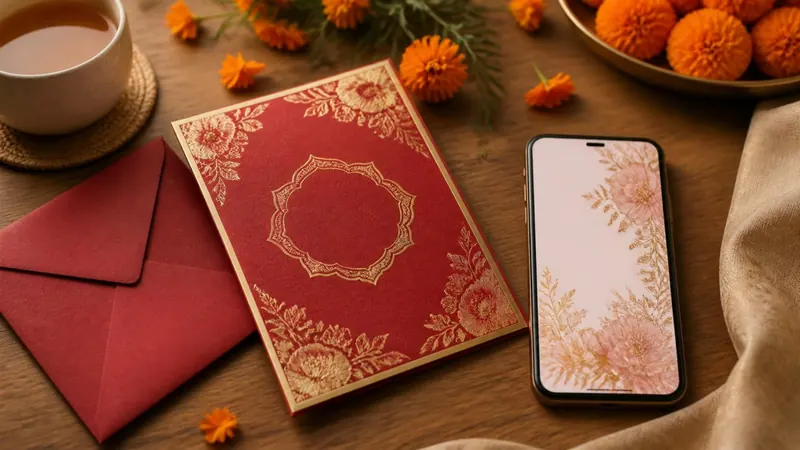
Red and gold lead most Nepali wedding cards, with marigold yellow and green close behind. Each colour echoes something guests see at the wedding itself, which is why the palette feels right even before anyone reads a word.
| Colour | Where it comes from in the wedding | What it is commonly taken to signify |
|---|---|---|
| Red (रातो) | Sindoor, the bridal sari, red glass bangles | Marriage and good fortune (common association) |
| Gold (सुनौलो) | Jewellery such as the tilhari pendant | Prosperity and festivity (common association) |
| Marigold yellow (पहेँलो) | Sayapatri garlands, the yellow pote necklace | Welcome and blessing (common association) |
| Green (हरियो) | The green glass beads of the tilhari, mango leaves | Married life and fresh growth (common association) |
Some notes on the sources behind that table:
- Red. The Wikipedia entry on sindoor describes the vermilion powder a husband first applies to his wife's hair parting on the wedding day. A bridal designer told The Kathmandu Post that red was once the main bridal colour and that brides now also choose other shades, especially for the reception and mehendi.
- Green and yellow. Onlinekhabar's guide to wedding jewellery describes the tilhari as strings of green pote (glass beads) with a gold pendant, and the pahelo pote as a necklace of yellow beads the groom places on the bride.
- Marigold. The Kathmandu Post calls the marigold a favourite of Laxmi, the goddess of wealth and prosperity, and describes garlands hung from eaves and doorways at Tihar.
Softer palettes are now common too: ivory, blush pink, sage green, deep plum or midnight blue as the base, with red or gold kept as an accent.
Motifs on Nepali Wedding Cards and What They Mean
A motif is the picture that tells guests what kind of occasion this is. One or two are enough. Here are the ones Nepali cards use most.
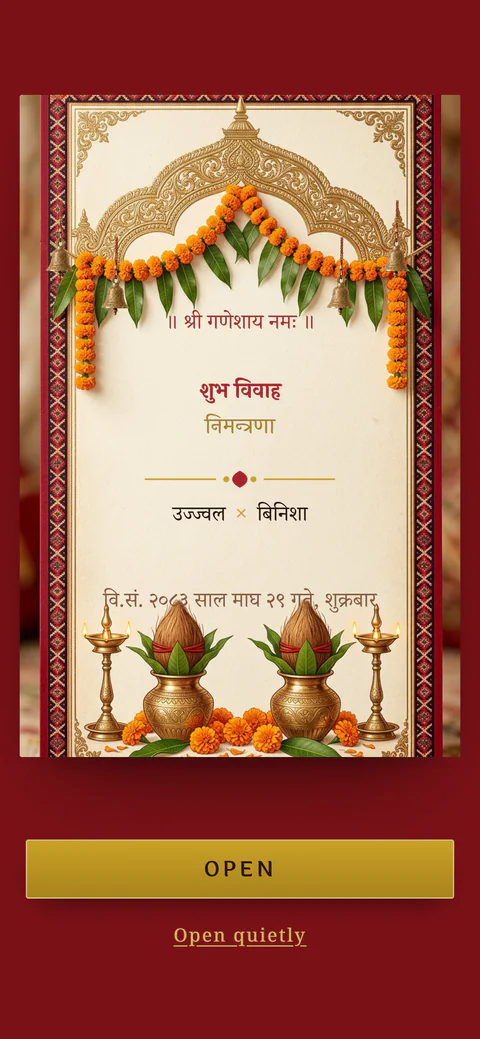
- Ganesh (गणेश). According to Wikipedia's entry on Ganesha, he is the remover of obstacles and is honoured at the start of rites and ceremonies. That is why his image or the line ॥ श्री गणेशाय नमः ॥ often sits at the top of a Hindu card.
- Kalash (कलश). A metal pot filled with water and topped with mango leaves and a coconut. The Kalasha entry describes it as a symbol of abundance, wisdom and immortality, placed near the doorway as a sign of welcome.
- Swastika (स्वस्तिक). The Hindu and Buddhist auspicious sign. The word comes from Sanskrit and means "conducive to well-being", says Wikipedia, which notes its use on doorways and in Hindu ceremonies such as weddings.
- Sayapatri garlands (सयपत्री). Strings of marigold, the flower of welcome at Nepali doors.
- Toran (तोरण). A hanging of mango leaves and flowers across a doorway, described in the Toran entry as a symbol of good fortune used at festivals and weddings.
- Dhaka pattern (ढाका). The geometric woven cloth of the Dhaka topi. Wikipedia names Palpa and Tehrathum among the main weaving districts. As a border, it says "Nepal" without any religious meaning.
- Newari wooden windows (आँखीझ्याल). The carved lattice window of the Kathmandu Valley, called tikijhya in Nepal Bhasa. The Newar window entry calls these windows a symbol of Newar culture and artistry.
- Peacock (मयूर). A favourite of woodcarvers and painters. The famous peacock window of Bhaktapur is one example.
- Mandala and lotus (मण्डला, कमल). Round, balanced forms shared by Hindu and Buddhist art. The lotus is commonly linked with purity.
- Mountains (हिमाल). A view of the Himalaya places the wedding in Nepal at a glance and carries no religious meaning.
- Rhododendron (लालीगुराँस). The bright red national flower of Nepal, which blooms in spring. It suits a spring wedding in the hills.
Typography in Devanagari and Roman
Good type on a Nepali card means two things: the Devanagari is large and correct, and the card uses no more than two font families. Everything else is taste.
Devanagari letters hang from a top line and carry marks above and below, so they need more size and more space between lines than English text. A practical order of sizes:
- The couple's names: the largest text on the card.
- The heading शुभ विवाह (Shubha Bibaha, "auspicious wedding"): decorative type is fine here.
- Date, time and venue: plain, clear type. No script fonts.
- Parents' names and the request: smaller, but still easy for an elder to read.
For Roman text, a serif or a fine script suits names, and a simple face suits details. Match the weight of the two scripts so that neither looks pasted on.
Contrast matters as much as size. The web accessibility standard from the W3C asks for a contrast ratio of at least 4.5 to 1 between normal text and its background. Thin gold lettering on cream fails that test, however rich it looks in a shop sample.
For the words themselves, see our guide to wedding invitation wording in Nepali and English.
Seven Styles of Nepali Wedding Card and Who They Suit
Most Nepali wedding card designs fall into seven styles. The table maps each one to its mood and the families it tends to suit, with a Nimtto design as an example where one fits.
| Style | Mood | Who it suits | Example |
|---|---|---|---|
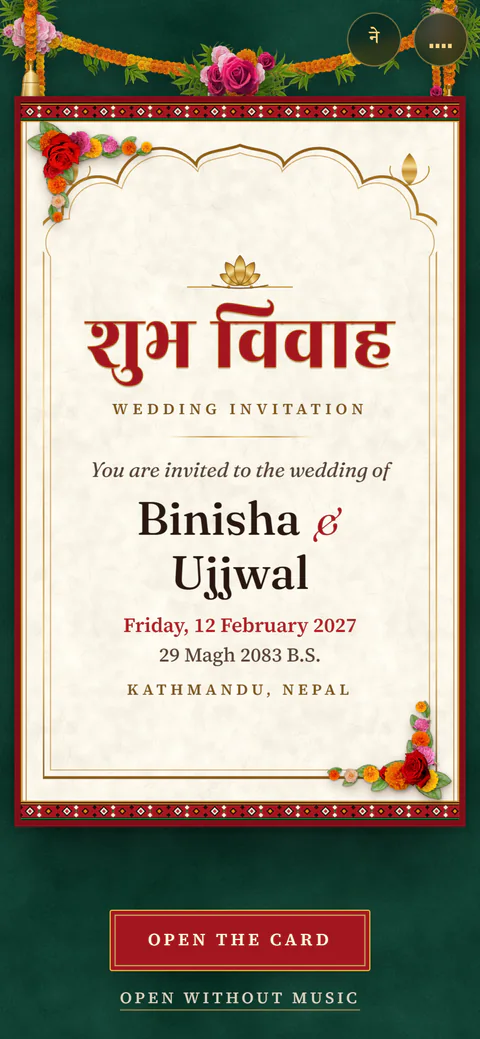
| Traditional | Formal, sacred, familiar | Families who want elders to feel at home | Nimantrana: a red and gold card with Ganesh, the couple, then the programme |
| Royal | Grand, evening, gold | Hotel or banquet receptions | Mahal: a golden palace gate tied with a satin bow |
| Floral | Fresh, warm, welcoming | Garden venues and daytime weddings | Sayapatri: a doorway hung with marigold strings |
| Minimal | Calm, clean, modern | Couples hosting in their own names | Dhoka: a clean white card with the golden door of Patan |
| Modern | Soft colour, playful detail | Mehendi and reception invitations, younger guest lists | Laali: blush pink and gold with lanterns |
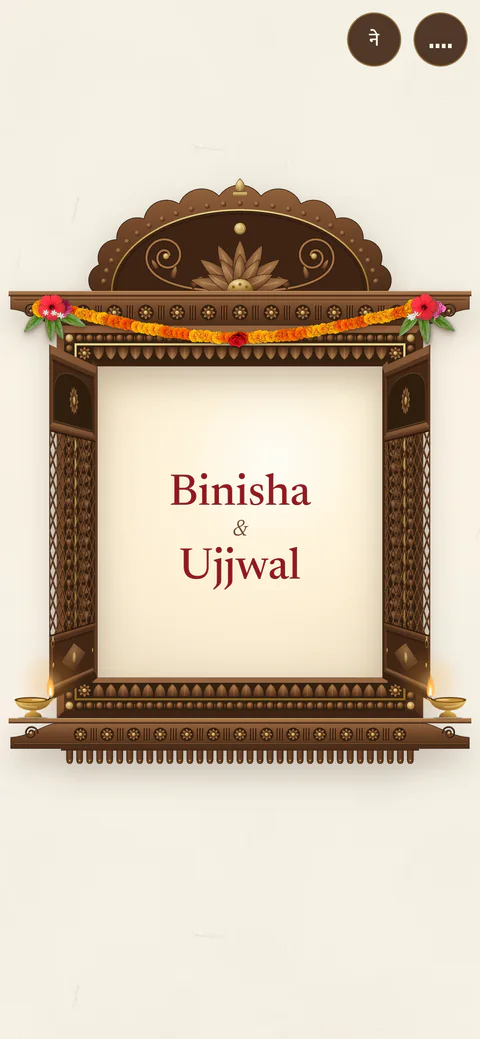
| Heritage and regional | Rooted in a place or craft | Families proud of a town or art form | Jhyal: a carved Newari window whose shutters open |
| Scenic | Open, quiet, inclusive | Inter-faith couples and guests abroad | Himal: sunrise over the Himalaya |
A style is a starting point, not a box. A traditional card can be made calm with more empty space, and a minimal card can carry one small Ganesh at the top.
Regional and Community Styles
Nepal has many wedding traditions, and a card can honour one without copying it badly. The safest way is to use that community's own art, checked by someone from the family.
- Newar heritage. Carved windows, brick courtyards and temple squares of the Kathmandu Valley. Jhyal uses a carved Newari window.
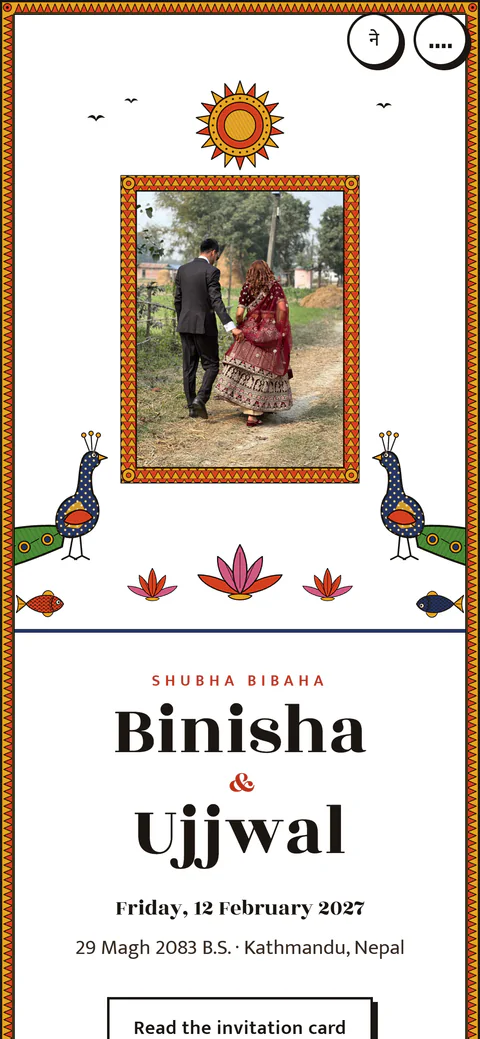
- Mithila art. The painting tradition of the Mithila region of Nepal and Bihar, traditionally made by women and tied to occasions such as birth and marriage, according to Wikipedia's entry on Madhubani art. Chitra is a picture book in Mithila art.
- Hill textiles. Dhaka cloth works as a border or a band. The Dhaka design opens an envelope with a Dhaka band.
- Buddhist, Kirat, Christian, Muslim and mixed families. Many choose flowers, scenery or pattern in place of a Hindu deity, and add their own blessing line. Ask your elders or your religious teacher which symbols are right.
How to Choose a Design That Fits
Choose the design by answering four questions in order: who is hosting, where the wedding is, who will read the card, and what must be on it.
- The couple and the hosts. A card sent in the parents' names usually leans traditional. A card from the couple can be lighter.
- The venue. A palace gate suits a banquet hall. A flower gate suits a garden. A carved window suits an old-town courtyard.
- The readers. If many guests are grandparents, favour large Devanagari and a familiar look. If many are colleagues or friends abroad, add English and keep symbols simple.
- The content. Count your ceremonies. A card with a mehendi, a wedding day and a bhoj (the wedding feast) needs room for three sets of time and place.
Then test it. Show the draft to one elder and one friend. If either has to search for the date, the design is not finished.
If you are still choosing between an image, a card maker and a designer-made link, our comparison of online wedding invitation options in Nepal sets out the costs.
What to Avoid on a Wedding Card
Most weak cards fail on reading, not on beauty. These are the common faults.
- Crowded text. Five ceremonies, four generations of names and a verse on one face. Split it: one face for the invitation, one for the programme.
- Low contrast. Gold on cream, red on maroon, white on pale pink.
- Tiny Devanagari. If an elder needs glasses and a lamp, it is too small.
- Too many fonts. Two families are enough. Three scripts of lettering look like three different cards.
- Motifs piled up. Ganesh, kalash, swastika, peacocks, lotus and a floral border at once. Pick one hero and one supporting detail.
- Dull or faded flowers. Fresh marigold and rose colours read as celebration.
- Only one calendar. Show the date in Bikram Sambat and AD.
- Unchecked spelling. Names in both scripts must be read by the family before anything is printed or sent.
How a Digital Design Differs From a Printed One
A digital design is not a picture of a printed card. It moves, it can be tapped, and it can change after you send it.
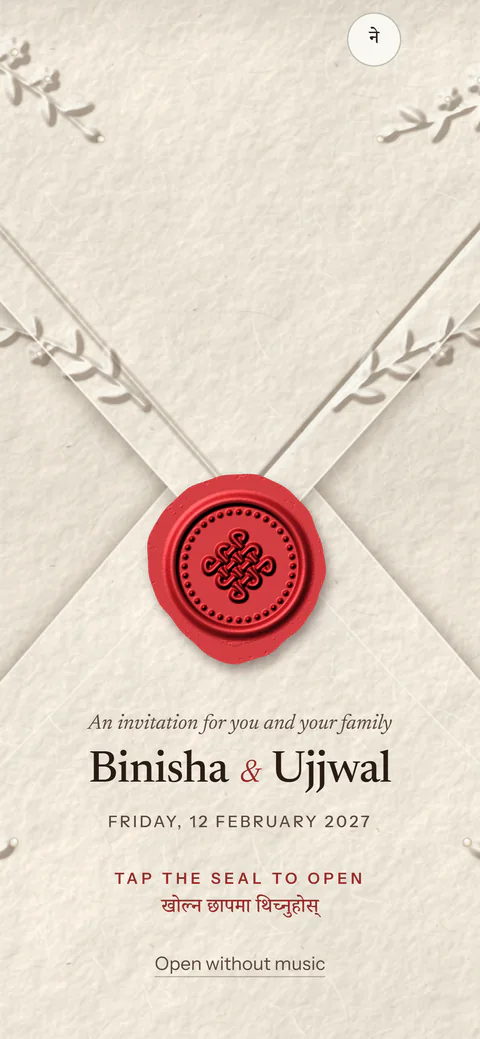
- An opening animation. The first screen can be a door, an envelope or a garland that opens. In Sayapatri, marigold strings lift to show the invitation.
- Music. A printed card is silent. A digital one can play a tune as it opens.
- Photos and your story. Space that paper does not have.
- Every ceremony with its own map. Guests tap for directions.
- RSVP. Guests reply on the card itself.
- Room for two languages. Guests switch between English and Nepali, so neither is squeezed.
Print still has strengths: it can be held, handed over with respect and kept in an album. Our comparison of digital and printed wedding cards in Nepal explains how many families use both.
Finding Your Own Design
Start with your venue and your eldest readers, pick one colour family and one motif, and keep the type large and calm. That alone will put your card ahead of most.
If you would like to see these ideas as finished invitations, browse the 40 Nepali designs on the Nimtto designs page. A designer sets up your names, dates and ceremonies with you, and the pricing page lists every plan.
Questions people ask
What colours are used on a Nepali wedding card?
Red and gold are the most common, followed by marigold yellow and green. Red is tied to sindoor and the bridal sari, gold to jewellery, yellow to marigold garlands and green to the glass beads of the tilhari necklace. Many modern cards use ivory, blush pink or deep plum as the base and keep red or gold as an accent.
Why is Ganesh printed on Nepali wedding cards?
Because Ganesh is honoured at the start of rites and ceremonies as the remover of obstacles. Many Hindu families place his image or the line ॥ श्री गणेशाय नमः ॥ at the top of the card for that reason. It is a family choice, not a rule: Buddhist, Kirat, Christian, Muslim and mixed families often choose a design without a deity.
What is the best design for a wedding invitation?
The best design for a wedding invitation is the one that fits the couple, the venue and the family's community, and that guests can read easily. Check three things: the names and date are clear at a glance, the Devanagari text is large enough for elders, and the style matches the event, for example a palace gate for a formal bhoj or flowers for a garden wedding.
Is the swastika on a Nepali wedding card a religious symbol?
Yes. The swastika (स्वस्तिक) is an old Sanskrit-named sign that means conducive to well-being, and it is used as a symbol of divinity and good fortune in Hinduism, Buddhism and Jainism. If your card will go to guests abroad who may not know this, add one line that explains it, or choose another auspicious motif such as a kalash.
Which font is good for a Nepali wedding card in Devanagari?
Choose a Devanagari font with clear conjuncts and a steady top line, and use it at a larger size than the English text beside it. Keep to two font families on the whole card: one for headings and one for details. Always ask an elder to read the names aloud before printing or sending, because a wrong matra in a name is easy to miss.
What is the difference between a traditional and a modern Nepali wedding card?
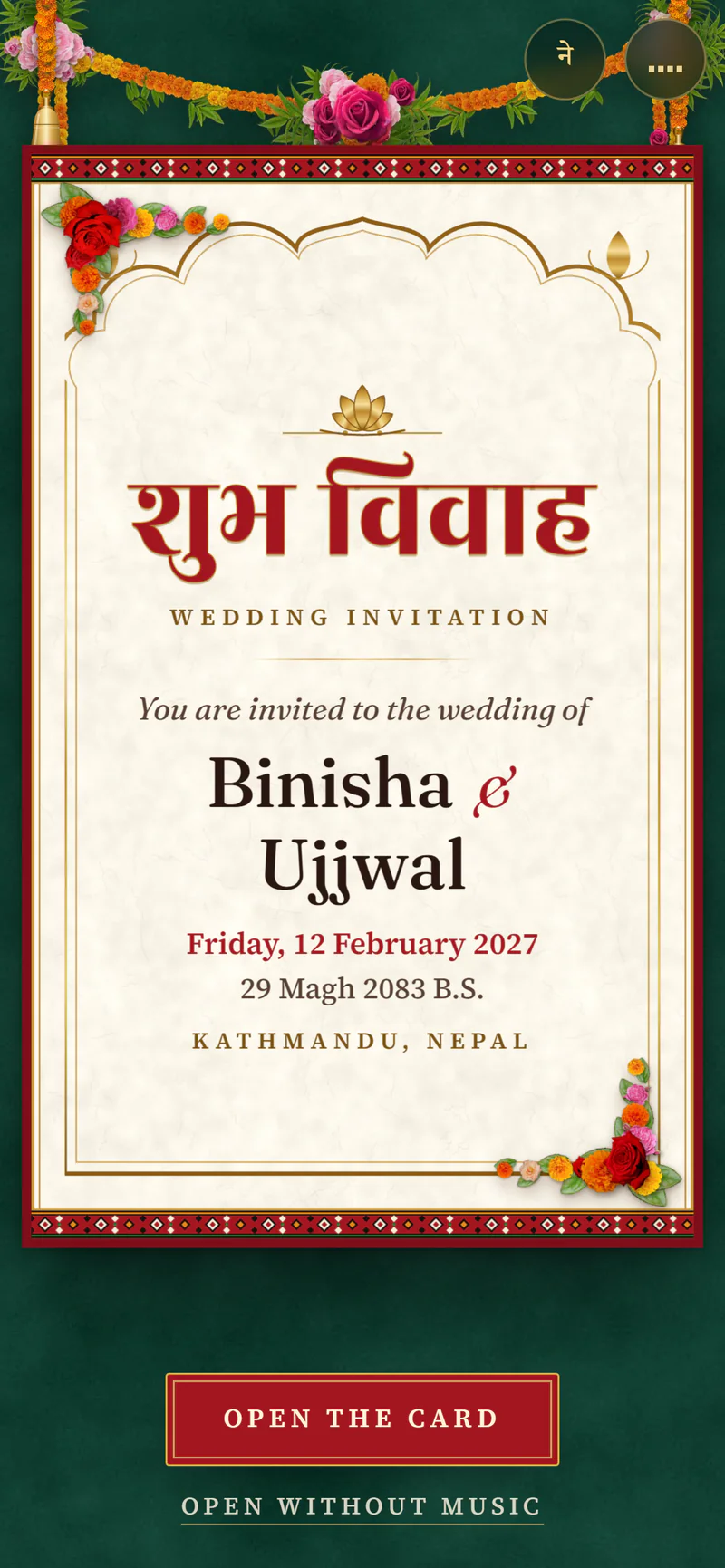
A traditional card uses red and gold, a Ganesh image, a kalash or a decorative border, and formal Nepali wording from the parents. A modern card uses fewer elements: more empty space, softer colours such as ivory or blush, one motif, and often English beside the Nepali. Both can carry the same information, so the choice is about mood.
Can a Nepali wedding card design avoid religious symbols?
How is a digital wedding card design different from a printed one?
A digital design moves and can be tapped. It can open with an animation, play music, show photos, list every ceremony with a map and collect replies, and it can be corrected after sending. A printed design is fixed and limited by the size of the paper, but it can be held and kept. Many families use both.