Nepali Wedding Card Terms: Chi., Sau., Saait and More
A plain-English glossary of the abbreviations and set phrases on a Nepali wedding card, from चि. and सौ. to साइत, जन्ती and दर्शनाभिलाषी, with Devanagari, meaning and a correct example line for each.

The Nepali wedding card terms that puzzle readers most are short blessings and set phrases. चि. (Chi.) stands for चिरञ्जीवी, "long-lived", and goes before the groom's name. सौ. (Sau.) stands for सौभाग्यवती, "blessed with good fortune", and goes before the bride's name. साइत (saait) is the auspicious time, जन्ती (janti) is the groom's wedding procession, and प्रीतिभोज (preetibhoj) is the wedding feast.
This glossary explains each term in plain English, with the Devanagari spelling, a Roman spelling, who it is used for and a correct example line. Usage is not the same in every home. Where a point depends on family or community habit, we say so. For full card texts, see our wedding invitation wording in Nepali and English, or the Nepali-language guide Bihe Ko Card Ma Ke Lekhne.
Quick Table of Nepali Wedding Card Terms
These are the words you will meet on almost every Hindu Nepali wedding card, in the order they usually appear. The sections below give the detail and an example for each.
| Term | Roman spelling | Plain meaning | Where it goes |
|---|---|---|---|
| श्री गणेशाय नमः | Shree Ganeshaya Namah | Salutations to Lord Ganesh | Top of the card |
| शुभ विवाह | Shubha Bibaha | Auspicious wedding | Heading |
| चि. (चिरञ्जीवी) | Chi., chiranjivi | Long-lived (a blessing) | Before the groom's name |
| सौ. (सौभाग्यवती) | Sau., saubhagyawati | Blessed with good fortune | Before the bride's name |
| सौ.कां. (सौभाग्यकाङ्क्षिणी) | Sau. Kan., saubhagyakankshini | One who wishes for good fortune | Before the bride's name, until the wedding |
| आयुष्मान् / आयुष्मती | ayushman / ayushmati | Long-lived (male / female) | Before the groom's / bride's name |
| श्री, श्रीमान् | shree, shreeman | Mr | Before a man's name |
| श्रीमती | shreemati | Mrs | Before a married woman's name |
| सुश्री | sushree | Ms | Before a woman's name |
| स्व. (स्वर्गीय) | Swa., swargiya | The late | Before the name of someone who has died |
| सुपुत्र / सुपुत्री | suputra / suputri | Son / daughter | After the parents' names |
| नाति / नातिनी | nati / natini | Grandson / granddaughter | After the grandparents' names |
| ज्येष्ठ / कनिष्ठ | jyestha / kanistha | Eldest / youngest | Before सुपुत्र or सुपुत्री |
| शुभ साइत | shubha saait | Auspicious time | Beside the main rite |
| लगन | lagan | Auspicious wedding day or season | In talk more than on the card |
| स्वयम्बर | swayambar | Exchange of garlands | Programme |
| जन्ती | janti | The groom's wedding procession | Programme, groom's card |
| प्रीतिभोज, भोज | preetibhoj, bhoj | Wedding feast or reception | Programme |
| सपरिवार | sapariwar | With your family | Request line |
| निमन्त्रक | nimantrak | The inviter, the host | Signature |
| निवेदक, विनीत | nibedak, binit | The one who requests, humbly yours | Signature |
| दर्शनाभिलाषी | darshanabhilashi | Those who wish to see you | List of relatives at the end |
| वि.सं., साल, गते | B.S., saal, gate | Bikram Sambat, year, day of the month | Date line |
| तदनुसार | tadanusar | Corresponding to | Before the AD date |
Blessings Before the Couple's Names: चि., सौ. and आयुष्मान्
The short words before the bride's and groom's names are blessings from the elders who send the card, not titles the couple hold. They ask for a long life and good fortune. A card uses one matching pair: चि. with सौ. or सौ.कां., or आयुष्मान् with आयुष्मती.
चि. (चिरञ्जीवी, Chiranjivi)
चिरञ्जीवी means "long-lived". The Sanskrit, Hindi and Nepali dictionaries collected by Wisdom Library all give that sense, and the Kannada entry on the same page records it as a word an elder uses for a younger person. On a Nepali card it sits before the groom's name.
- Used for: the groom, when parents or grandparents are the hosts.
- Example: श्री [बुबाको नाम] तथा श्रीमती [आमाको नाम]का सुपुत्र चि. [दुलहाको नाम]
सौ. (सौभाग्यवती) and सौ.कां. (सौभाग्यकाङ्क्षिणी)
सौभाग्यवती literally means a woman who has good fortune. The dictionaries quoted by Wisdom Library are more exact: Monier-Williams gives "a married and unwidowed woman", and its Nepali-English dictionary gives the senses of a woman whose husband is alive, and of being fortunate or blessed.
That is why careful writers use a second form for a bride who is not yet married: सौभाग्यकाङ्क्षिणी, "one who wishes for good fortune", shortened to सौ.कां. (also printed सौभाग्यकांक्षिणी). In practice many Nepali cards simply print सौ. before the bride's name as a blessing. Both are seen, so ask your elders.
- Used for: the bride. सौ. is also used for any married woman whose husband is living.
- Example: श्री [बुबाको नाम] तथा श्रीमती [आमाको नाम]की सुपुत्री सौ.कां. [दुलहीको नाम]
- On a reception card after the wedding: सौ. [दुलहीको नाम]
आयुष्मान् and आयुष्मती (Ayushman, Ayushmati)
आयुष्मान् also means "long-lived". Sanskrit dictionaries listed by Wisdom Library describe it as an old, respectful form of address. आयुष्मान् is for a man and आयुष्मती is for a woman, so the pair suits families who want the same blessing for both.
- Used for: the groom (आयुष्मान्) and the bride (आयुष्मती).
- Example: आयुष्मान् [दुलहाको नाम] र आयुष्मती [दुलहीको नाम]को शुभ विवाह
Honorifics for Parents and Elders: श्री, श्रीमती, सुश्री and स्व.
Every adult named on the card gets an honorific, and it stays the same from the first line to the last. श्री or श्रीमान् is for a man, श्रीमती for a married woman, सुश्री for a woman when you do not wish to mark marriage, and स्व. for a person who has died.
- श्री / श्रीमान् (shree, shreeman): "Mr". श्रीमान् is a little more formal. Example: श्रीमान् [बुबाको नाम].
- श्रीमती (shreemati): "Mrs". Example: श्रीमती [आमाको नाम]. Parents are usually joined with तथा or एवं, both meaning "and": श्री [नाम] तथा श्रीमती [नाम].
- सुश्री (sushree): close to "Ms". It appears more on guest names and envelopes than in the family lines.
- स्व. (स्वर्गीय, swargiya): "the late". The Nepali-English dictionary quoted by Wisdom Library gives "deceased" and "the late" among its senses. Example: स्व. [हजुरबुबाको नाम]का नाति, "grandson of the late [Grandfather's name]".
Our guide to who sends the wedding invitation and whose name comes first covers the order of these names.
Family Words: सुपुत्र, सुपुत्री, नाति and नातिनी
These words tie the bride and groom to the elders named above them. सुपुत्र means son and सुपुत्री means daughter, with the prefix सु ("good") added as a mark of affection. नाति is a grandson and नातिनी a granddaughter.
- सुपुत्र / सुपुत्री: written after the parents' names. Note the grammar: का सुपुत्र for a son, की सुपुत्री for a daughter.
- नाति / नातिनी: written after the grandparents' names. Example: श्री [हजुरबुबाको नाम] तथा श्रीमती [हजुरआमाको नाम]की नातिनी.
- ज्येष्ठ / कनिष्ठ (jyestha, kanistha): "eldest" and "youngest". Example: ज्येष्ठ सुपुत्र, "eldest son". Everyday words such as जेठा, माहिला, साहिँला and कान्छा (first, second, third and youngest son) are also used.
- वर / वधू (bar, badhu): formal words for the groom and the bride. दुलहा and दुलही, or बेहुला and बेहुली, are the everyday words.
Opening Lines: श्री गणेशाय नमः and शुभ विवाह
A Hindu Nepali card opens with a short invocation and then the heading शुभ विवाह.
॥ श्री गणेशाय नमः ॥ (Shree Ganeshaya Namah) means "salutations to Lord Ganesh". Wikipedia's article on South Asian wedding cards notes that Hindu invitations open by invoking a deity, and that Ganesh is worshipped first because he is believed to clear obstacles.
Some families add a short Sanskrit verse below it, chosen by the elders or the priest.
शुभ विवाह (Shubha Bibaha) means "auspicious wedding". शुभ is "auspicious" and विवाह is the formal word for marriage; बिहे is the everyday word. Families of other faiths and traditions use their own opening line, or none at all. Nothing on a card is compulsory.
Ceremony Words: साइत, लगन, स्वयम्बर, जन्ती and प्रीतिभोज
The programme section uses a small set of ceremony words. Each one tells the guest where to be and when.
- शुभ साइत (shubha saait): the auspicious moment for a rite. A Hindi-English dictionary quoted by Wisdom Library defines साइत as a moment or hour, including an auspicious moment. Example: शुभ साइत: बिहान ९:१५ बजे.
- लगन (lagan): the auspicious day or season for weddings. People say "लगन सुरु भयो" when the wedding season opens. Onlinekhabar explains that astrologers work these dates out from the panchanga, and that the Nepal Panchanga Nirnayak Samiti decides the dates each year. Your own priest sets your saait.
- स्वयम्बर (swayambar): on a card today, the rite where the bride and groom exchange garlands, and in many families rings. The word comes from Sanskrit svayam, "self", and vara, "choice", says Wikipedia: in the old epics the bride chose her husband by placing a garland on him. Also spelled स्वयंवर.
- जन्ती (janti): the people who go with the groom to the bride's place, as the Nepali-English dictionary on Wisdom Library defines it. Example: जन्ती प्रस्थान: बिहान ८:०० बजे, [घरको ठेगाना]बाट. प्रस्थान means "departure".
- कन्यादान (kanyadan): the rite in which the bride's parents give their daughter in marriage. It appears on the bride's family card.
- प्रीतिभोज (preetibhoj): "feast of affection", the wedding dinner or reception. भोज (bhoj) alone means a feast. Example: प्रीतिभोज: बेलुका ६:०० बजेदेखि.
Closing Words: सपरिवार, दर्शनाभिलाषी, निमन्त्रक and निवेदक
The last part of the card makes the request and names the people who make it, so check these words twice.
- सपरिवार (sapariwar): "with family". Example: हजुर सपरिवार उपस्थित भई नवदम्पतीलाई आशीर्वाद दिनुहुन हार्दिक अनुरोध गर्दछौं। ("We warmly request you and your family to come and bless the newly-weds.")
- इष्टमित्रसहित (ishtamitra sahit): "together with friends and relatives". It widens the invitation further.
- निमन्त्रक (nimantrak): the inviter. The names under it are the hosts.
- निवेदक (nibedak): "the one who requests". It is a humbler heading for the same people. विनीत (binit), "humbly yours", is used in the same way.
- दर्शनाभिलाषी (darshanabhilashi): from दर्शन ("seeing, meeting") and अभिलाषी ("one who wishes"). It heads the list of relatives who look forward to seeing the guest. Example: दर्शनाभिलाषी: [हजुरबुबा], [हजुरआमा], [काका], [काकी].
निम्तो (nimto) and निमन्त्रणा (nimantrana) both mean "invitation": निम्तो is the everyday word and निमन्त्रणा the formal one.
Date and Time Words in Bikram Sambat
A Nepali card gives the date in Bikram Sambat (BS) first, then the AD date. Bikram Sambat is an official calendar of Nepal and runs about 57 years ahead of AD, or 56 years from January to mid-April, according to Wikipedia's Vikram Samvat article.
A full date line reads: वि.सं. २०८३ साल फागुन १२ गते बुधबार (तदनुसार २४ फेब्रुअरी २०२७).
- वि.सं. (विक्रम संवत्): Bikram Sambat.
- साल (saal): year. गते (gate): the day of the BS month. तारिख (tarikh): the day of the AD month.
- रोज (roj): an older way to give the weekday as a number counted from Sunday. रोज ४ is Wednesday. Most cards now write बुधबार instead.
- तदनुसार (tadanusar): "corresponding to", placed before the AD date.
The twelve BS months, starting from mid-April, are वैशाख (Baisakh), जेठ (Jestha), असार (Asar), साउन (Saun), भदौ (Bhadau), असोज (Asoj), कात्तिक (Kattik), मङ्सिर (Mangsir), पुस (Push), माघ (Magh), फागुन (Falgun) and चैत (Chait). Each starts near the middle of an AD month, so फागुन runs from mid-February to mid-March.
Time words are simple: बिहान (morning), दिउँसो (daytime or afternoon), बेलुका or साँझ (evening), राति (night), बजे (o'clock) and बजेदेखि ("from ... o'clock onwards"). The weekdays are आइतबार, सोमबार, मङ्गलबार, बुधबार, बिहीबार, शुक्रबार and शनिबार, from Sunday to Saturday.
Common Mistakes With Card Terms
Most errors come from copying an old card without checking that each word fits your own family. Where we call something common usage, families differ and your elders have the last word.
- Using सौ. without thinking about its meaning. By the dictionary, सौभाग्यवती describes a married woman. The stricter form before the wedding is सौ.कां. Many families print सौ. anyway, as a blessing. Pick one on purpose.
- Mixing two pairs of blessings. चि. goes with सौ. or सौ.कां., and आयुष्मान् with आयुष्मती. Do not write both before one name.
- Using चि. when the couple are the hosts. चि. is an elder's blessing for a younger person. On a card sent in the couple's own names, it is common usage to drop it.
- Writing श्री for a parent who has died. Use स्व. before the name. Some families write स्व. श्री; either way, a late parent is named in the family line and not as a host.
- Mismatched का and की. It is का सुपुत्र for a son and की सुपुत्री for a daughter.
- Writing सपरिवार by habit. It invites the whole household. Use it only if you mean it.
One Card With Every Term in Place
This short bride's-side card uses the terms above in their usual places. Change the names in square brackets. The date is only an example; your priest sets your own saait.
॥ श्री गणेशाय नमः ॥

शुभ विवाह

स्व. [हजुरबुबाको नाम] तथा श्रीमती [हजुरआमाको नाम]की नातिनी
श्री [बुबाको नाम] तथा श्रीमती [आमाको नाम]की ज्येष्ठ सुपुत्री
सौ.कां. [दुलहीको नाम]
र
श्री [दुलहाका बुबाको नाम] तथा श्रीमती [दुलहाकी आमाको नाम]का सुपुत्र
चि. [दुलहाको नाम]

को शुभ विवाह वि.सं. २०८३ साल फागुन १२ गते बुधबार (तदनुसार २४ फेब्रुअरी २०२७) का दिन हुने भएकाले हजुर सपरिवार उपस्थित भई नवदम्पतीलाई आशीर्वाद दिनुहुन हार्दिक अनुरोध गर्दछौं।

जन्ती स्वागत: दिउँसो ३:०० बजे
स्वयम्बर: बेलुका ४:०० बजे
शुभ साइत: बेलुका ५:१५ बजे
प्रीतिभोज: बेलुका ७:०० बजेदेखि
स्थान: [भेन्यूको नाम], [ठेगाना]

निमन्त्रक
[बुबाको नाम], [आमाको नाम]

दर्शनाभिलाषी
[काका, काकी, दाजु, भाउजू, दिदी, बहिनीको नाम]
समस्त [थर] परिवार
Putting the Terms on Your Own Invitation
Once you know what each word means, choosing is easy: one invocation, one pair of blessings, the same honorific for every elder, and the date in both calendars. Ask an elder to read the final text aloud before it goes out.
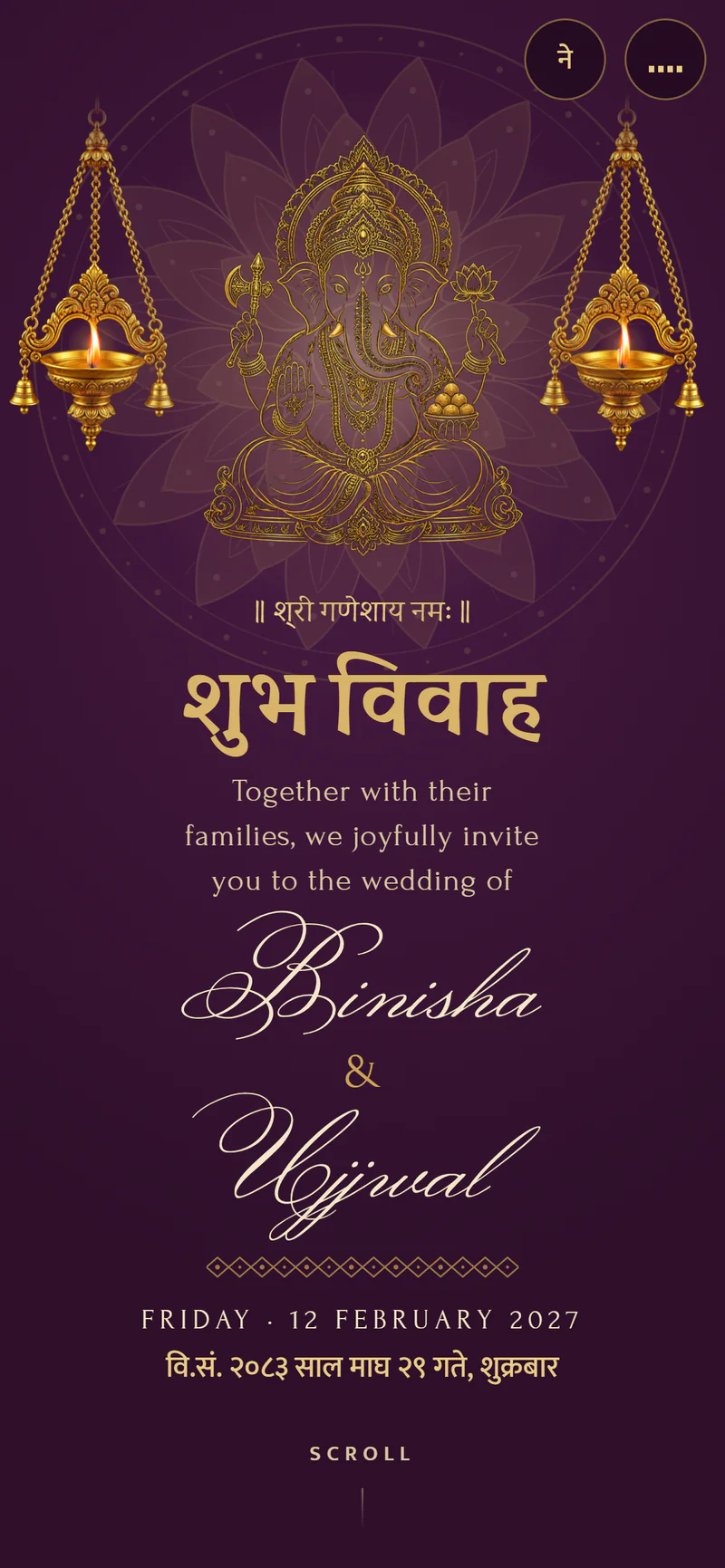
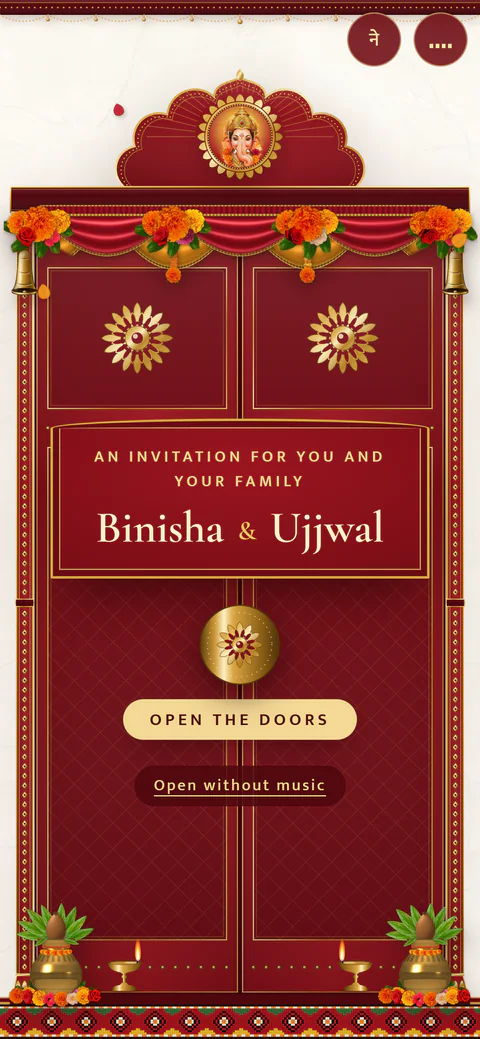
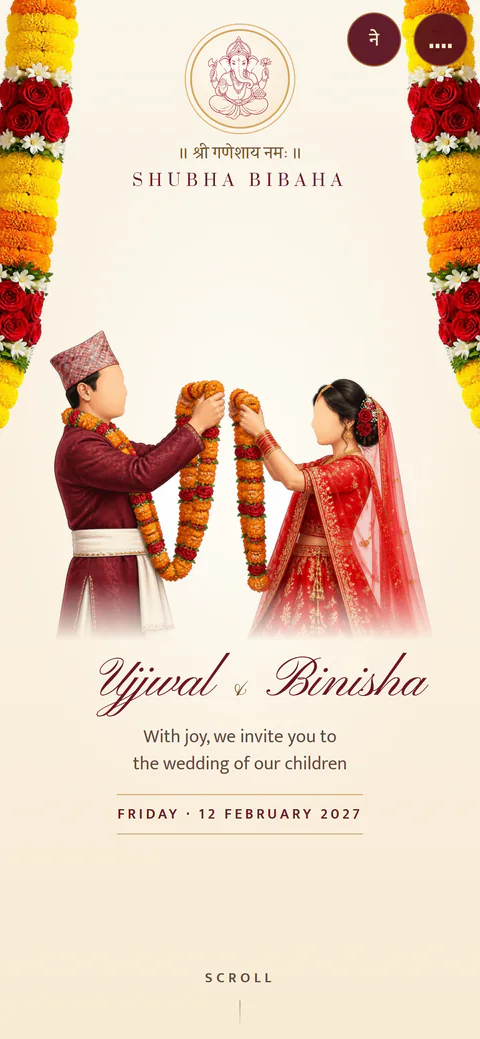
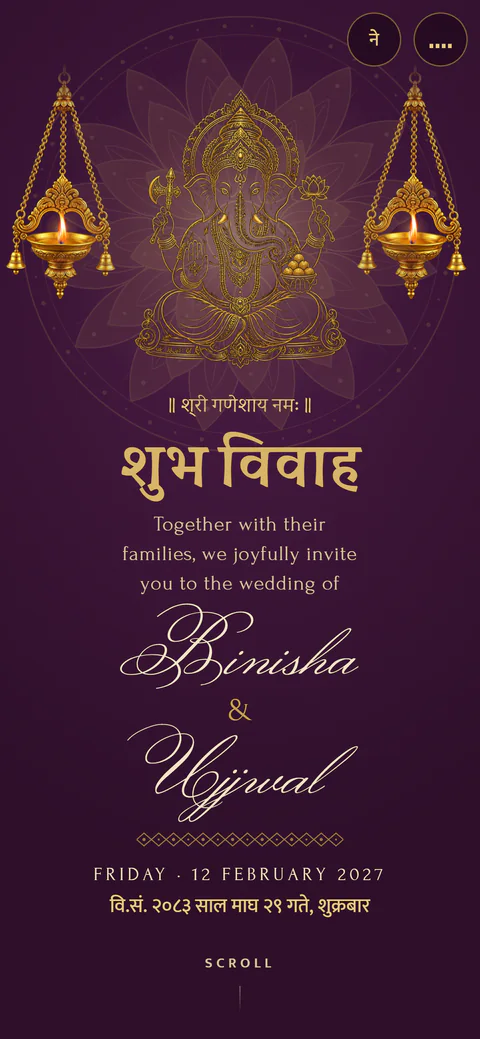
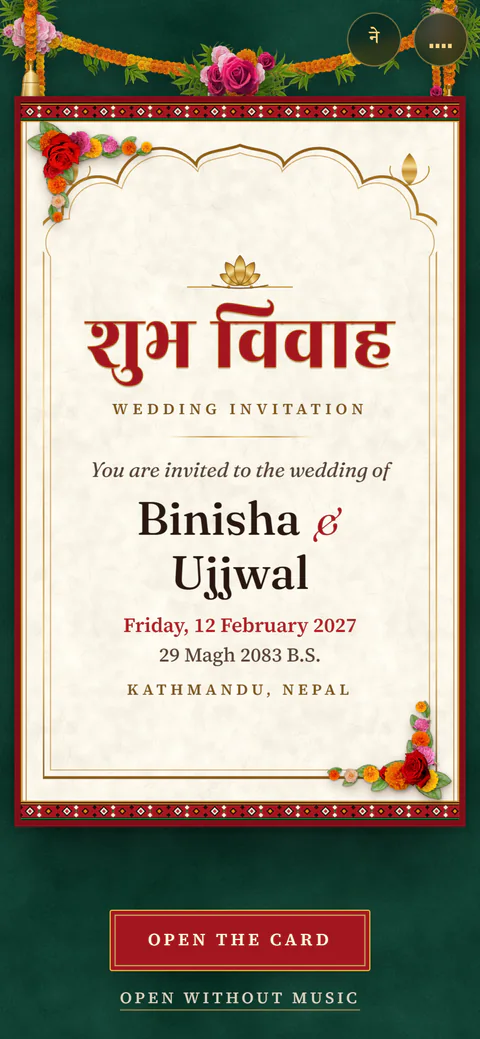
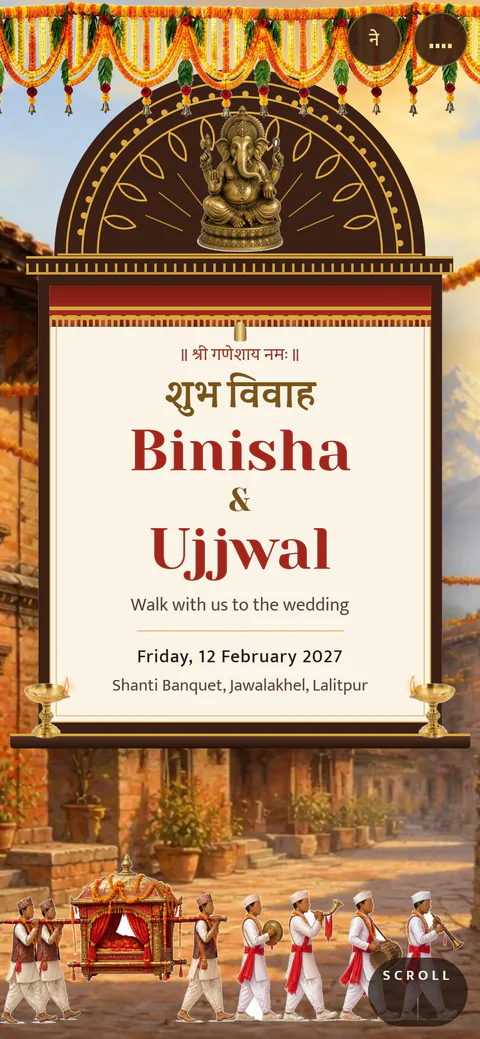
If you would like these words set on an online card, a Nimtto designer sets up your wording in Nepali and English with you, so the terms above appear the way your family writes them. The Shree design opens on a gold Ganesh, Mangal opens a red temple door on शुभ विवाह, and Nimantrana unfolds as a red and gold card. Have a look at the wedding invitation designs, read about a Nepali wedding card online, or check the prices when you are ready.
Questions people ask
What does चि. (Chi.) mean on a Nepali wedding card?
चि. is short for चिरञ्जीवी (chiranjivi), which means "long-lived". It is a blessing that elders place before the name of a younger person, and on a Nepali wedding card it usually sits before the groom's name, as in चि. [दुलहाको नाम]. It is not part of his name, and you do not say it aloud when you greet him.
What does सौ. (Sau.) mean, and what is सौ.कां.?
सौ. is short for सौभाग्यवती (saubhagyawati), "blessed with good fortune", a word dictionaries define as a married woman whose husband is living. सौ.कां. is short for सौभाग्यकाङ्क्षिणी, "one who wishes for good fortune", and is the more careful form before the bride's name until the wedding. Many Nepali cards print either one, so follow your family's habit.
What is the difference between आयुष्मान् and चि.?
Both are blessings that mean "long-lived", and both go before the groom's name. आयुष्मान् (ayushman) has a feminine pair, आयुष्मती (ayushmati), so families who want matching words for the groom and the bride often choose that pair. Families who write चि. for the groom usually write सौ. or सौ.कां. for the bride. Use one pair, not both.
What does saait mean, and how is it different from lagan?
साइत (saait) is the auspicious moment chosen for a rite, such as the minute the main wedding ritual should begin. लगन (lagan) is used more loosely for the auspicious wedding day, or for the wedding season as a whole. A card gives the day in the date line and the saait as a clock time. Your own priest or astrologer sets both.
What does दर्शनाभिलाषी mean at the bottom of a wedding card?
दर्शनाभिलाषी (darshanabhilashi) means "those who wish to see you". It is the heading above the list of family members who join the hosts in welcoming guests, usually grandparents, uncles, aunts and siblings, with seniors first. It is different from निमन्त्रक, which names the people who are sending the invitation.
How do you write a late parent's name on a Nepali wedding card?
Write स्व. before the name. It is short for स्वर्गीय (swargiya), which means "the late". For example: स्व. [बुबाको नाम] तथा श्रीमती [आमाको नाम]का सुपुत्र. A late parent is named in the family line but is not listed as a host who invites. Some families write स्व. श्री together, so ask your elders which they prefer.
What does सपरिवार mean on an invitation?
सपरिवार (sapariwar) means "with your family". When the card says हजुर सपरिवार उपस्थित भई, the whole household of the person named is invited, not only that one person. If you add इष्टमित्रसहित, you are also welcoming their friends and relatives. Leave both out if you can only host the guest named on the card.
What does गते mean in a Nepali wedding date?
गते (gate) marks the day of the month in the Bikram Sambat calendar. In २०८३ साल फागुन १२ गते, the year is 2083, the month is Falgun and the day is the 12th. Cards usually add the weekday and then the AD date after the word तदनुसार, which means "corresponding to".