Who Sends the Wedding Invitation in Nepal, and Whose Name Comes First?
In most Nepali families each side sends its own wedding card, with its own child named first. Here is how hosts, names, late parents, guest lists, elders and joint or court-marriage cards are usually handled.

If you are asking who sends the wedding invitation in Nepal, the usual answer is both families, separately. The bride's parents invite their own relatives and friends, and the groom's parents invite theirs. Each family is the host (निमन्त्रक, nimantrak) of its own card and names its own child first. Joint cards and cards sent by the couple are also used now.
That is the widespread pattern, not a law. Nepal's 2021 census counted 142 castes and ethnic groups, as The Kathmandu Post reported, and each community, and each family within it, has its own way of inviting. Use this guide as a starting point and let your elders decide the fine points.
Who Is the Host (निमन्त्रक) on a Nepali Wedding Card?
The host is the person or family whose name appears under निमन्त्रक (inviter), निवेदक (the one who requests) or विनीत (humbly yours) at the end of the card. On a traditional card that is the parents of the bride or of the groom, not the couple.
There are four common kinds of card today.
| Kind of card | Who is the host | Whose name comes first | Often used for |
|---|---|---|---|
| Family card, groom's side | The groom's parents, sometimes the grandparents | The groom | Janti, wedding and reception guests of his family |
| Family card, bride's side | The bride's parents, sometimes the grandparents | The bride | Guests who welcome the janti and attend the rites |
| Joint card | Both sets of parents together | Agreed by both families | One shared event, or a shared reception |
| Couple's card | The bride and groom, "with our families" | Agreed by the couple | Friends, colleagues, receptions, weddings abroad |
A simple way to choose: the host is whoever is inviting the guest and receiving them at the door. If your parents are doing that, the card goes out in their names. Our wedding invitation wording in Nepali and English has complete texts for each kind.
Whose Name Comes First: The Bride's or the Groom's?
On a family card, the child of the sending family comes first. The groom's parents write "our son" and then name the bride with her parents; the bride's parents write "our daughter" and then name the groom with his. On a joint card there is no single Nepali rule.
For a joint card or a couple's card, families usually settle it in one of these ways:
- The host's child first. If one family is hosting the venue and the feast, its child is named first.
- The same order as the event. A card for the reception at the groom's home puts the groom first; a card for the rites at the bride's venue puts the bride first.
- Two versions. The text is the same, but each family's copy opens with its own child.
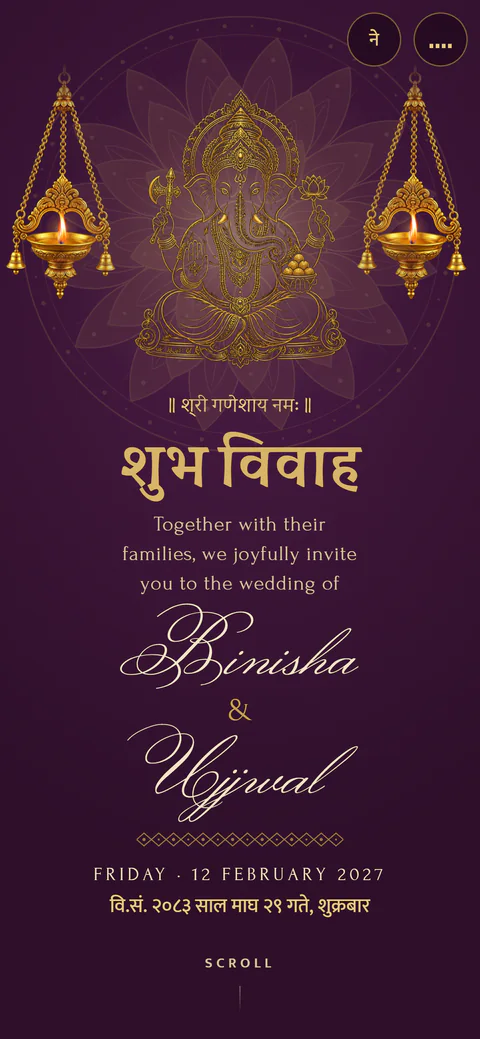
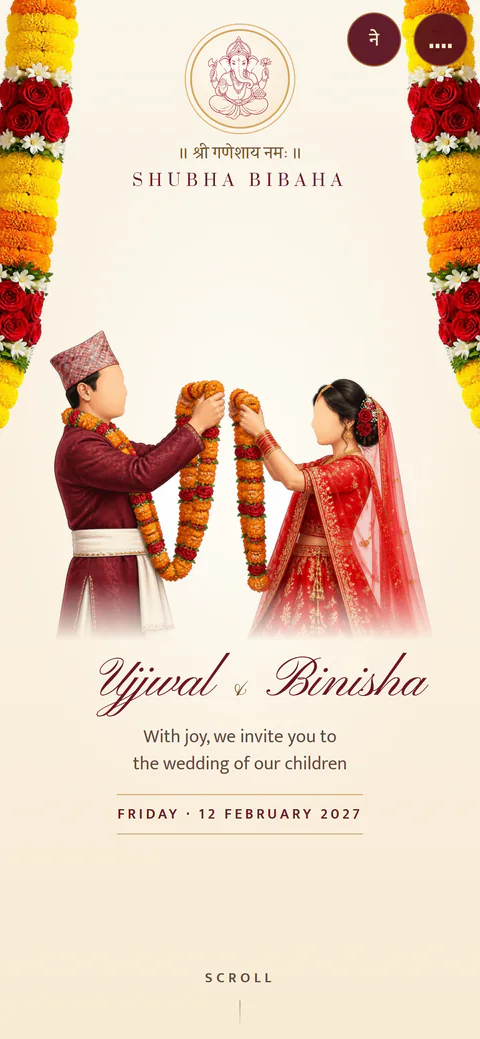
The third way is the easiest to keep everyone content. It is also simple online: Nimtto can make separate links for the bride's side and the groom's side, and each link shows that side's name first. The details are on the features page.
Whatever you choose, be consistent. If the card says "[Bride] and [Groom]", the envelope, the WhatsApp message and the welcome board should say the same.
How Parents and Grandparents Are Ordered
Names run from senior to junior. Grandparents come before parents, the father's name usually comes before the mother's, and the couple come after the elders who introduce them. This is common usage, and some families now write the mother's name first or give both parents equal lines.
A typical family line reads:
श्री [हजुरबुबाको नाम] तथा श्रीमती [हजुरआमाको नाम]का नाति
श्री [बुबाको नाम] तथा श्रीमती [आमाको नाम]का सुपुत्र
चि. [दुलहाको नाम]
In English: "Chi. [Groom's name], grandson of Mr and Mrs [Grandparents' names], son of Mr and Mrs [Parents' names]."
A few points families often check:
- Honorifics match. If one father is श्रीमान्, the other is too. Titles such as Dr are a family choice.
- Both sides get the same weight. If you name your own grandparents, consider naming the other side's parents in full as well.
- The signature list is ordered by seniority. Under दर्शनाभिलाषी ("those who wish to see you") come grandparents, then uncles and aunts, then brothers and sisters.
- Maternal relatives. Some families list the मामा (mother's brother) near the top of the list. Ask your elders where he belongs on yours.
Every one of these words is explained in our glossary of Nepali wedding card terms.
How to Name a Late Parent on the Card
Write स्व. before the name of a parent or grandparent who has died, and keep them in the line that introduces the bride or groom. स्व. is short for स्वर्गीय (swargiya), which the Nepali-English dictionary quoted by Wisdom Library defines as "deceased" or "the late".
स्व. [बुबाको नाम] तथा श्रीमती [आमाको नाम]की सुपुत्री
सौ.कां. [दुलहीको नाम]
The harder question is who signs as host. A late parent is honoured in the family line but does not invite. Families commonly do one of the following:
- The living parent signs alone as निमन्त्रक.
- The living parent signs with an elder son, an uncle (काका or मामा) or the grandparents.
- The whole family signs, as समस्त [थर] परिवार ("the whole [surname] family").
Some families write स्व. श्री together, and some prefer not to print a late parent's name at all. Neither is wrong. Ask the surviving parent what feels right before anyone else decides.
Bride's-Side and Groom's-Side Cards and Guest Lists
Each side keeps its own guest list and often hosts its own feast, which is why two cards are so common. The cards share the couple's names and the date, but the programme on each is different.
| Groom's-side card | Bride's-side card | |
|---|---|---|
| Guests | The groom's relatives, neighbours, friends and colleagues | The bride's relatives, neighbours, friends and colleagues |
| Asks guests to | Join the janti (wedding procession) and the reception | Welcome the janti and attend the rites |
| Times to print | Janti departure, bride's welcome home, reception | Janti welcome, swayambar, wedding rites, feast |
| Signed by | The groom's parents and family | The bride's parents and family |
Two reports show how separate the two sides can be. A Newar bride writing on the Nepali Australian blog describes a bride's-side reception of close to 1,000 guests that the groom's family did not attend, because it was for her family's guests. A wedding photographer told The Kathmandu Post that groom's-side bookings usually run 10 to 11 hours and bride's-side bookings 8 to 10 hours: two sides, two schedules.
Practical points for two guest lists:
- Share the lists once, so that mutual friends are not invited twice or missed by both.
- Agree on the spelling of all four parents' names, and use it on both cards.
- Give each side a contact person of its own.
- Count replies per side. The caterers are usually different.
Inviting Elders in Person, and What Families Do With Links
Close elders are usually invited face to face. Many families still carry the card to grandparents, senior relatives, the family priest and respected neighbours, and only afterwards send messages to everyone else. The visit is the invitation; the card records it.
Personal invitation is older than the printed card. In close-knit Newar communities, betel nuts (supari) were once given in place of invitations, according to the travel writer behind Full Time Explorer, who describes her own Newar wedding. ECS Nepal describes how, in one Newar group, a go-between called a lami goes with the groom's sister to the bride's home at the engagement, carrying betel nuts and gifts.
Printed cards still matter for the same reason. The Kathmandu Post found that many people in Kathmandu still favour them, and a designer told The Rising Nepal that e-vites will not replace paper soon, because a printed card means a great deal to parents.
What many families do now is mix the two:
- Print a small number of cards for elders and hand them over in person.
- Phone the elders who live too far away to visit, then send the link to a son, daughter or grandchild in the same house.
- Send the link to everyone else with a personal message.
The same Rising Nepal report tells of a bride from Lalitpur who sent an e-vite with a customised voice message to each of about 200 guests. The lesson is that the personal touch matters more than the paper. Our comparison of digital and printed wedding cards in Nepal covers costs and the mixed approach in detail.
Inviting by Phone or WhatsApp Politely
A phone or WhatsApp invitation is polite when it is personal: the guest's name, who is getting married, the date, and a sincere request to come. What offends is a forwarded message to a large group with no greeting.
For a senior relative, call first. A short script:
नमस्कार [काका]। हजुरलाई सञ्चै छ?
हाम्रो छोरा [दुलहाको नाम]को बिहे फागुन १२ गते पक्का भएको छ। घरमै आएर निम्तो दिनुपर्ने हो, टाढा भएकाले फोनबाटै निम्तो दिएको छु, नरिसाउनुहोला।
हजुर सपरिवार जसरी पनि आइदिनुपर्छ। कार्ड र लिंक [नाम]को मोबाइलमा पठाउँछु।
In English: "Namaskar, Uncle. Our son's wedding is fixed for 12 Falgun. I should have come in person, but we are far away, so please forgive me for inviting you by phone. You and the family must come. I will send the card and the link to [Name]'s mobile."
Then send the written message:
नमस्कार [नाम] ज्यू,
अघि फोनमा भनेअनुसार हाम्रा छोरा [दुलहाको नाम] र [दुलहीको नाम]को शुभ विवाहको निम्तो यस लिंकमा छ: [लिंक]
हजुर सपरिवार उपस्थित भई आशीर्वाद दिनुहुन हार्दिक अनुरोध गर्दछौं।
[बुबाको नाम] तथा [आमाको नाम]
An online invitation link can carry each guest's name, so the page itself greets the person you sent it to. That small detail does much of the work a handwritten name on an envelope used to do.
Inter-Caste, Inter-Faith and Court-Marriage Receptions
The same principles apply: the host is whoever invites, both families are named with equal respect, and the card says only what the families are comfortable saying. There is no special wording that such a card must carry.
A court marriage followed by a reception is a familiar pattern. A couple can register their marriage at a district court under the Civil Code 2017, as Onlinekhabar explains. The Kathmandu Post reported in April 2026 that Bhaktapur District Court registered 668 marriages in the fiscal year, up from 353 the year before, and described one couple who followed their court marriage with a family dinner and a reception the next day. The same report notes that inter-caste couples often choose this route, and quotes a sociologist who says legal validity and family acceptance are separate matters.
Some wording choices that keep a card neutral and warm:
- Leave out what divides. An opening line such as ॥ श्री गणेशाय नमः ॥ is optional. Families of two faiths often use "With the blessings of our elders" or no invocation.
- Name both families the same way. The same honorifics, the same number of lines.
- Invite to what is happening. If the legal marriage is done, invite guests to "a reception to celebrate the marriage of", not to a wedding rite.
- Let the couple host if the families are still finding their way. A couple's card avoids putting any parent in a position they did not choose.
Together with our families
[Name] and [Name]
invite you to a reception
to celebrate our marriage

Friday, 26 February 2027 (Falgun 14, 2083 B.S.)
6:00 pm onwards
[Venue name], [Address]
The date in this sample is an example only. For help with any legal step, speak to the court or a lawyer; this guide covers wording alone.
How Customs Differ by Community
No single rule covers Nepal. Brahmin and Chhetri, Newar, Tamang, Gurung, Magar, Rai, Limbu, Madhesi, Tharu, Sherpa and other communities each have their own rites, their own go-betweens and their own ways of inviting, and families within one community differ too.
A few differences to ask your own elders about:
- Who carries the invitation. In some families the parents go, in some an elder brother or a maternal uncle, in some a go-between such as the Newar lami.
- What goes with it. Betel nuts, sweets, fruit or nothing at all.
- Whether a card is needed. In some places the invitation is still given by word of mouth, house to house.
- The opening line. Hindu, Buddhist, Kirat, Muslim and Christian families each open a card in their own way, or leave it plain.
- Which events guests of each side attend. In some communities the two sides feast separately; in others they share one reception.
If your two families follow different customs, write down both and choose together. Guests notice care far more than they notice which rule you followed.
Putting Your Decision on the Invitation
Decide four things in order: who the host is, whose name comes first, how the elders are named, and how each group of guests will be invited. Then write the card once and adapt it for each side.
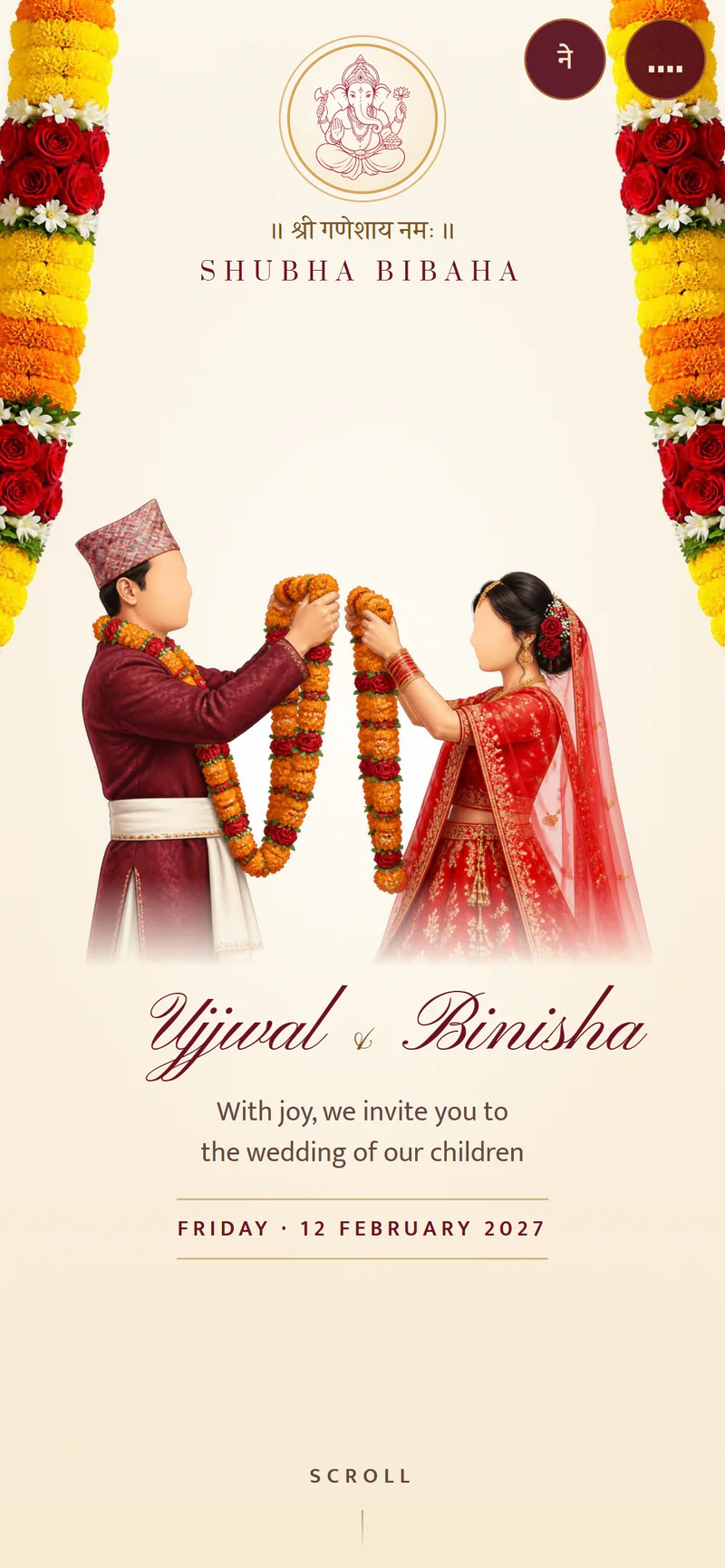
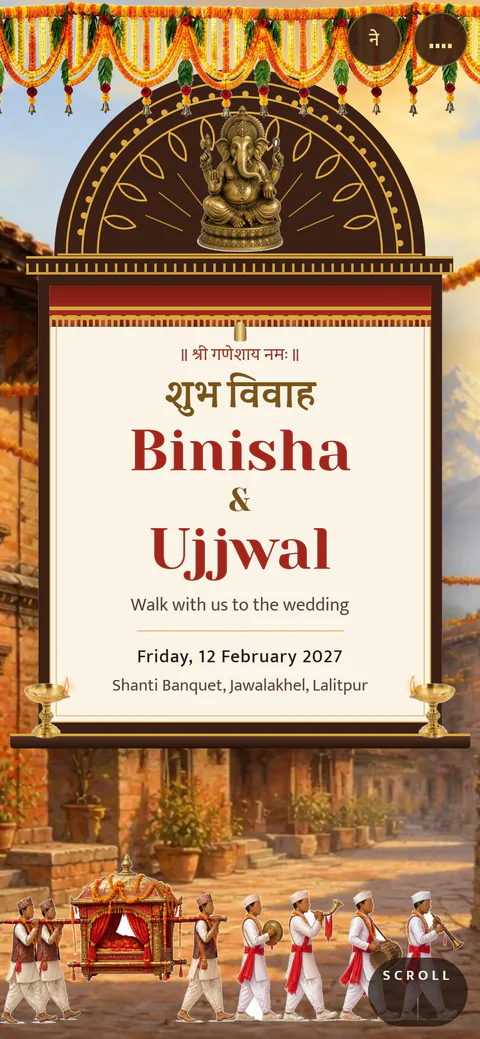
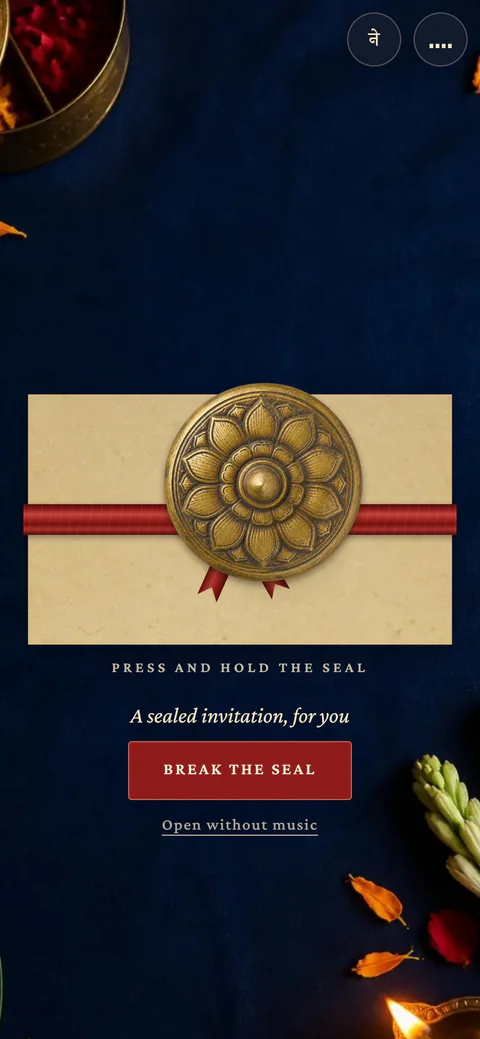
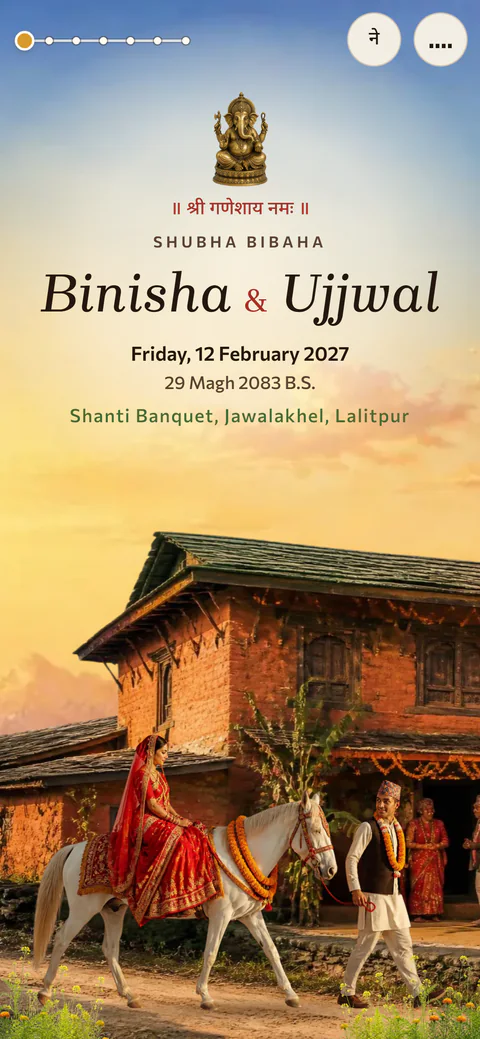
If you are sending an online invitation, a Nimtto designer sets up the names and the order the way your families agree, in Nepali and English. The Swayambar design brings the two sides together as two garlands, Janti walks guests down an old street with the Naumati Baja band, and Mohar opens like a sealed decree. See all the wedding invitation designs or check the prices when you are ready.
Questions people ask
Who sends the wedding invitation in Nepal, the bride's family or the groom's?
Usually both, separately. In most Nepali families the bride's parents send a card to their own relatives and friends, and the groom's parents send another to theirs. Each family is the host (निमन्त्रक) of its own card. Joint cards from both families, and cards sent by the couple themselves, are also used now, mostly in cities and for receptions.
Whose name comes first on a Nepali wedding card, the bride's or the groom's?
On a family card, the child of the family that sends it usually comes first: the groom on the groom's-side card and the bride on the bride's-side card. On a joint card there is no single rule in Nepal, so the two families should agree on the order together. Whichever you choose, keep it the same on every page and message.
Do the bride's and groom's families print separate wedding cards in Nepal?
Many do. Each side has its own guest list, its own programme and often its own feast, so a separate card is practical. The groom's card gives the janti departure and the reception, and the bride's card gives the time to welcome the janti and the wedding rites. Some families now share one design and change only the names and the programme.
How do you write a late father's or mother's name on a wedding card?
Write स्व. (short for स्वर्गीय, "the late") before the name in the line that introduces the bride or groom, for example स्व. [बुबाको नाम] तथा श्रीमती [आमाको नाम]का सुपुत्र. A late parent is honoured there but is not listed as a host. The living parent, an elder brother, an uncle or the grandparents usually sign as the hosts.
Is it acceptable to invite elders to a Nepali wedding on WhatsApp?
For close elders, a message alone is usually not enough. Many families still visit grandparents, senior relatives and family priests in person, or at least phone them, and then send the card or link. For other guests a personal WhatsApp or Viber message with their name, a warm line and the link is widely accepted. A forwarded group message feels careless.
Can the couple send the wedding invitation in their own names?
Yes. Couples who host their own wedding or reception often write "together with our families" and add both sets of parents' names below. It is common usage to drop elder's blessings such as चि. on such a card. If your parents care about tradition, a card in their names for relatives and a couple's card for friends works well.
What do we write on the card if we had a court marriage and are holding a reception?
Invite guests to the reception and say the wedding has taken place, for example "to celebrate the marriage of [Name] and [Name]". You do not need to mention the court. Give the date, time and venue of the reception and name the hosts, who may be the parents, both families or the couple. This is wording guidance only, not legal advice.