Nepali Wedding Ceremonies in Order, and How to List Them on the Card
The events of a Nepali wedding in order, what happens at each, who is usually invited, and copy-ready programme lines in Nepali and English for your invitation.

The main Nepali wedding ceremonies in a typical Hindu hill (Brahmin and Chhetri) wedding run in this order: the engagement, an optional mehendi or sangeet, the janti procession, swayambar, the rites at the mandap (kanyadan, sindoor and pote, and the rounds of the fire), bidai, the welcome at the groom's home, and the reception or bhoj. Each one needs its own line on the invitation.
Nepal has many wedding traditions, and no single order is true for all of them. This guide describes one common pattern, names its sources, and notes how other communities differ. For your own wedding, your priest and your elders decide the rites and the times.
Nepali Wedding Ceremonies in Order: The Quick Table
This table lists the events in a common order, who is usually invited to each, and what to write on the card. Treat the guest column as a pattern, not a rule.
| Ceremony | Who is usually invited | What to write on the card |
|---|---|---|
| Engagement (tika-talo or maagni) | Close family from both sides | Often a separate small invitation or a phone call |
| Mehendi or sangeet | Family and friends, often by side | Name, date, evening time, venue, dress note |
| Janti (the groom's procession) | The groom's relatives and friends | Where it leaves from and the departure time |
| Swayambar | Both families and wedding guests | Its own line with a time, or "Janti welcome and swayambar" |
| Wedding rites at the mandap | Both families and close guests | "Wedding rites" with the start time, or "at the auspicious time" |
| Bidai (the bride's farewell) | The bride's family | Usually not printed |
| Welcome at the groom's home | The groom's household | Usually not printed |
| Reception or bhoj | The widest guest list | Date, "6:00 pm onwards", venue |
Before the Wedding: Engagement, Mehendi and Sangeet
The events before the wedding day are the engagement, which is old, and mehendi and sangeet, which are newer in many families. Only the engagement is a formal step between the two families.
Engagement (Tika-Talo or Maagni)
The engagement fixes the match in front of both families. Many families call it tika-talo (टीकाटालो) or maagni. ECS Nepal's feature on Nepali marriages describes the older Brahmin and Chhetri form, kura chhinne ("settling the talk"): the priests of both families meet at the bride's home after an astrologer has matched the birth charts and chosen an auspicious date. Today the couple often exchange rings and receive tika from elders.
- Who attends: close relatives of both sides.
- How long: commonly one to two hours, followed by a meal.
- On the card: it is usually held weeks or months earlier, so it gets its own small engagement invitation, not a line on the wedding card.
Mehendi and Sangeet
Mehendi is an evening when henna is drawn on the bride's hands, and sangeet is a night of music and dance. In many Nepali families both are borrowed customs. A wedding planner told The Kathmandu Post that Bollywood is one of the main reasons people now include events like mehendi and sangeet. A planner quoted by Republica sees it differently: such events existed, but were not celebrated on a grand scale.
- Who attends: family and friends, often mostly women at a mehendi.
- How long: an evening, commonly two to four hours.
- On the card: list it only for the guests invited to it.
The Janti Procession
The janti (जन्ती) is the groom's wedding procession: his family, relatives and friends travel with him to the bride's home or the venue. ECS Nepal describes the party setting out with a musical band, while a small group goes ahead with fruit and a letter to announce the arrival.
The band is often a panche baja (पञ्चे बाजा), the traditional ensemble that The Kathmandu Post lists among wedding services in Kathmandu. The bride's family receives the janti at the gate.
- Who attends: guests of the groom's side. The bride's guests wait at the venue.
- How long: it depends on the distance: an hour within a city, most of a day between districts.
- On the card: the groom's card must give the departure place and time. The bride's card gives the time the janti is welcomed.
Swayambar: The Exchange of Garlands
Swayambar (स्वयम्बर) literally means "self-choice". Today it is the moment the bride and groom accept each other before both families. In the account by ECS Nepal, the bride walks around the groom three times pouring water from a small vessel, the couple exchange garlands and rings, and the priest applies tika. The garlands are usually made of dubo grass, says Remitly's guide to wedding traditions in Nepal, though many couples now use flowers.
Timing differs. Some families hold swayambar when the janti arrives on the wedding day. Others hold it some days earlier as a separate event, sometimes together with the engagement.
- Who attends: both families and the invited guests.
- How long: commonly half an hour to an hour.
- On the card: give it its own line if it is on a different day. If it follows the welcome, write "Janti welcome and swayambar".
The Rites at the Mandap: Kanyadan, Sindoor and Pote, and the Fire
The heart of the wedding takes place at the mandap (मण्डप), the decorated canopy, also called the jagge (जग्गे), around a sacred fire. It is led by the priests and timed to the saait (साइत), the auspicious moment.
Three parts are named most often:
- Kanyadan (कन्यादान). The bride's parents formally give their daughter's hand to the groom. ECS Nepal describes the father handing the bride over at the mandap.
- Sindoor and pote (सिन्दूर र पोते). The groom places red sindoor in the parting of the bride's hair and puts a bead necklace around her neck. Onlinekhabar describes the pahelo pote, a necklace of yellow beads placed after kanyadan while the priest recites mantras, and the tilhari, green beads with a gold pendant that marks a married woman.
- The fire (अग्नि). The couple are joined by a white cloth called the lagan gantho (लगनगाँठो) and walk around the holy fire seven times, according to ECS Nepal.
The order of these steps and the details differ from priest to priest. Wikipedia's account of Chhetri wedding rites, which draws on the anthropologist John Gray, describes a series of rites performed over two days.
- Who attends: both families and close guests. Many guests greet the couple, eat and leave before the rites end.
- How long: several hours. Rites often run late into the night because the saait decides the time. Astrologers work out the wedding dates, and the Nepal Panchanga Nirnayak Samiti sets them each year, as Onlinekhabar explains.
- On the card: write "Wedding rites" with a start time. Do not print a minute-by-minute schedule.
Bidai and the Welcome at the Groom's Home
Bidai (बिदाइ) is the bride's farewell to her parents' home, and it is followed by her welcome into the groom's house. Both are family moments, not guest events.
ECS Nepal describes the couple leaving by car in the city or by doli (a palanquin) in villages. At the groom's home, his sisters and cousins perform an aarati and the bride steps over seven piles of paddy as she enters. Many families call this welcome dulahi bhitryaune (दुलही भित्र्याउने, "bringing the bride in").
- Who attends: the bride's family for bidai, the groom's household for the welcome.
- On the card: these are normally left off. If the janti returns with a meal at the groom's home, the groom's card can add one line.
The Reception or Bhoj
The reception, called bhoj (भोज) or preetibhoj (प्रीतिभोज, "feast of affection"), is the party with the widest guest list. Guests arrive through the evening, greet the couple on the stage, eat and leave.
In many families the bride's side hosts a meal on the wedding day and the groom's side hosts a reception a day or two later. Some hold one joint party. Banquet halls and hotels quote a price per plate, as the rates listed by The Kathmandu Post show, so the guest count matters. Our reception and bhoj page shows a bhoj-only invitation.
- Who attends: relatives, neighbours, colleagues and friends.
- How long: three to four hours, with guests coming and going.
- On the card: date, start time with "onwards" (देखि), and the venue. No end time is needed.
How Other Communities Differ
The pattern above is one tradition among many. A few examples, each from a named source, show how wide the range is.
- Newar. ECS Nepal describes an engagement in which the groom's family sends betel nuts (supari) in a silver bowl, a bride who gives supari to each member of her new family, and a feast that closes the rites. Newar girls also go through ihi, a childhood rite of symbolic marriage, as SBS Nepali explains.
- Sherpa. In the same ECS feature, the proposal is made by offering chhyang (home-made beer) to the bride's parents, and khata scarves are given during the wedding.
- Gurung. ECS describes a lama checking the horoscopes, gifts that include a pot of curd, and elders washing the couple's feet and giving tika.
- Tamang. A column in The Kathmandu Post notes that there is no kanyadan in the Tamang community and that a bride keeps her own surname.
- Muslim and Christian families hold a nikah or a church service, usually followed by a meal or reception.
If you are writing a card for a tradition that is not your own, ask the family for the correct names of the events. Do not translate them into the Brahmin and Chhetri terms.
How to Write the Programme on the Card
Write one line for each event, always in the same order: name, date, time, venue. That is all a guest needs.
- Put the Bikram Sambat date first with the weekday, and the AD date in brackets.
- Use the part of the day in Nepali: बिहान (morning), दिउँसो (afternoon), बेलुका (evening).
- Name the venue fully the first time. After that, "same venue" (सोही स्थान) is enough.
- Give the janti's departure place on the groom's card.
कार्यक्रम
मेहन्दी: २०८३ फागुन १० गते सोमबार, बेलुका ५:०० बजे, [स्थान]
जन्ती स्वागत तथा स्वयम्बर: २०८३ फागुन १२ गते बुधबार, बेलुका ४:०० बजे
विवाह संस्कार: बेलुका ५:०० बजेदेखि (शुभ साइतमा)
प्रीतिभोज: बेलुका ७:०० बजेदेखि
स्थान: [भेन्यूको नाम], [ठेगाना]कार्यक्रम
जन्ती प्रस्थान: २०८३ फागुन १२ गते बुधबार, दिउँसो २:०० बजे, [घरको ठेगाना]बाट
विवाह स्थल: [भेन्यूको नाम], [ठेगाना]
प्रीतिभोज: २०८३ फागुन १४ गते शुक्रबार, बेलुका ६:०० बजेदेखि, [भेन्यूको नाम]Programme Mehendi: Monday, 22 February 2027 (Falgun 10, 2083 B.S.), 5:00 pm, [Venue] Janti departs: Wednesday, 24 February 2027 (Falgun 12, 2083 B.S.), 2:00 pm, from [Home address] Janti welcome and swayambar: 4:00 pm, [Venue] Wedding rites: 5:00 pm onwards, at the auspicious time Reception (Preetibhoj): Friday, 26 February 2027 (Falgun 14, 2083 B.S.), 6:00 pm onwards, [Venue]
For the full card text around the programme, see our guide to wedding invitation wording in Nepali and English. Words such as saait, janti and preetibhoj are explained in the Nepali wedding card terms glossary, and when to send wedding cards in Nepal covers timing.
Showing Each Ceremony on an Online Invitation
An online invitation solves the hardest part of a printed programme: space. Each ceremony gets its own section, so nothing has to be squeezed.
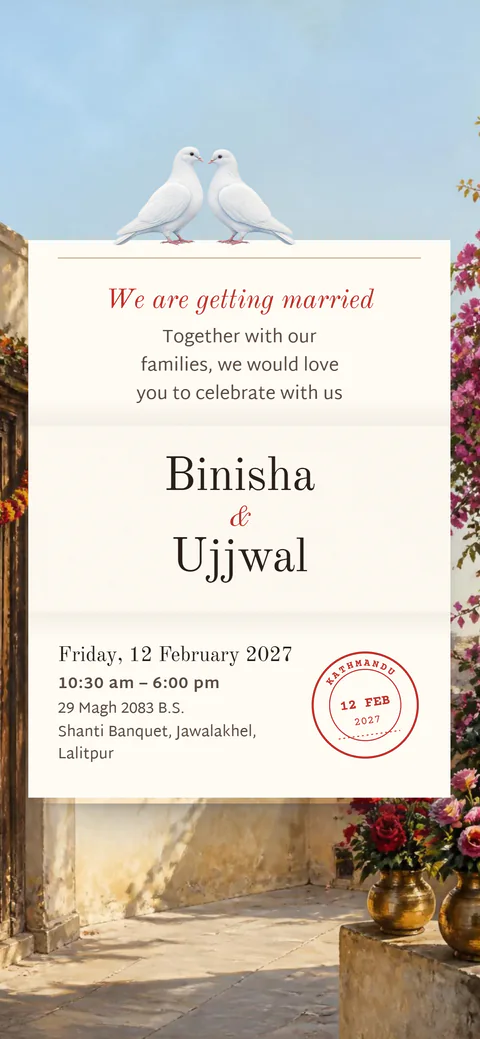
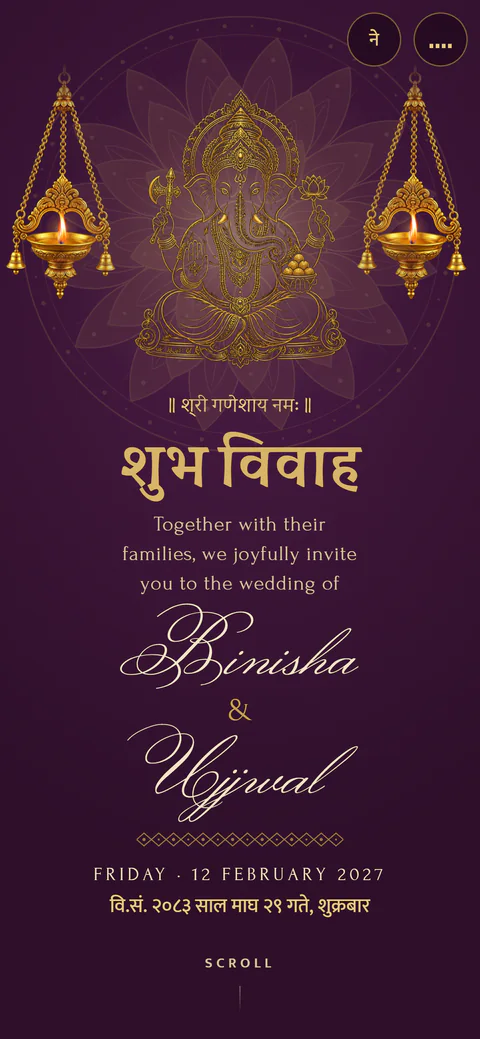
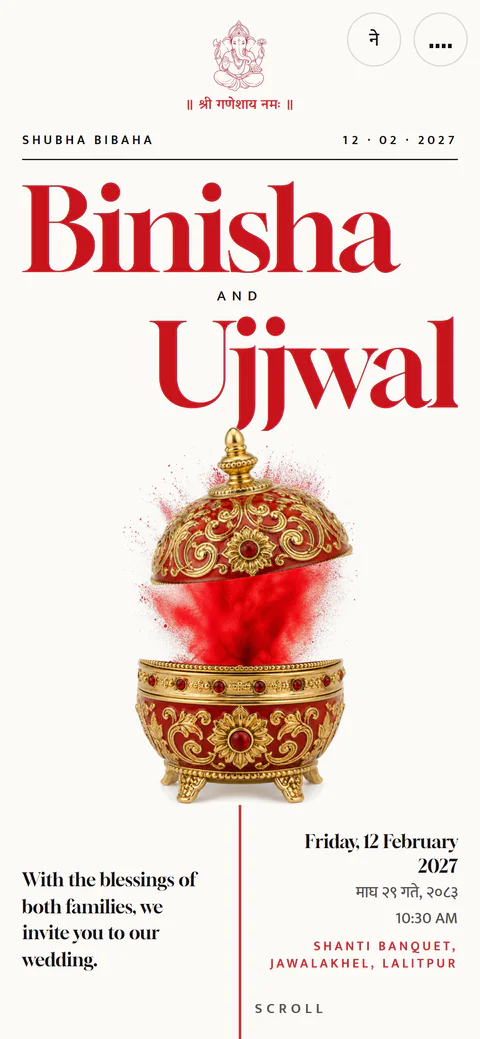
On a Nimtto invitation, every ceremony is shown with its time and a Google Maps link, the date appears in BS and AD, and guests reply for each ceremony separately. If the saait or the venue changes, you update it and the same link shows the new details. The features page lists everything an invitation shows.
Different guests can also be sent only the ceremonies they are invited to. Guest links can be made per ceremony, so a colleague opens an invitation to the bhoj alone, while close family sees the mehendi, the wedding day and the reception.
Putting Your Programme Together
List your events in order, fix each time with your priest and your venue, and write one clear line for each. Then decide which guests see which lines.
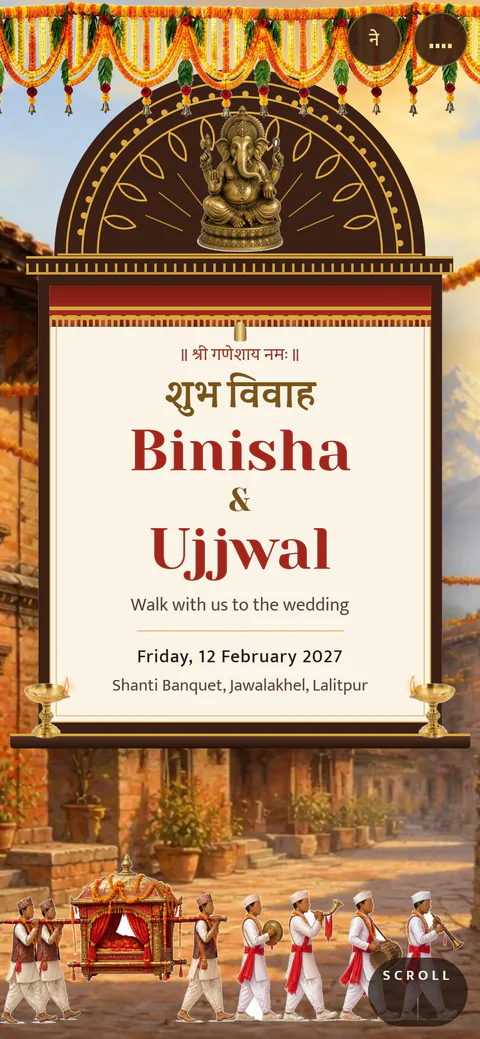
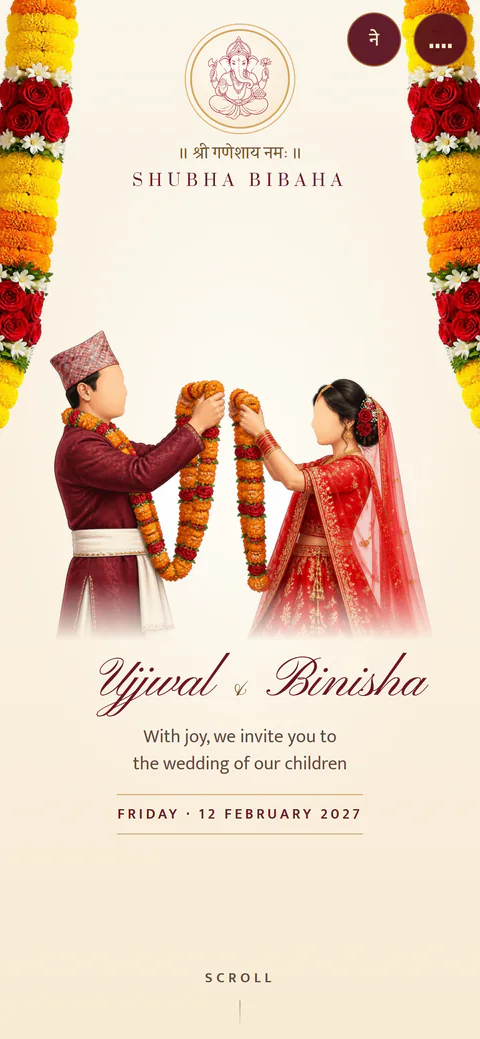
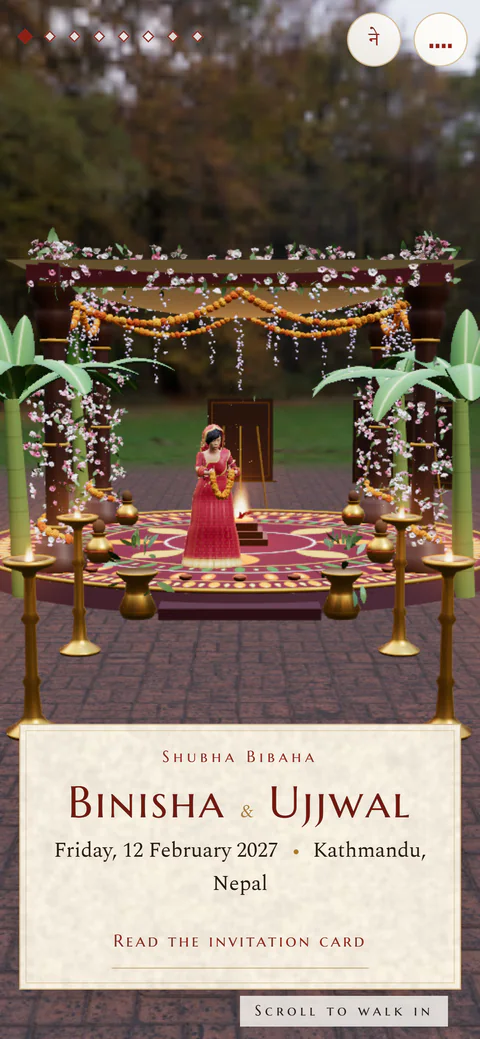
If you would like the ceremonies set out for you, look at the Nimtto designs, such as Janti, which walks with the band and the doli to the bride's door, or Swayambar, where two garlands swing apart. The pricing page lists every plan.
Questions people ask
What are the Nepali wedding ceremonies in order?
In many Hindu hill families the order is: engagement (tika-talo or maagni), an optional mehendi or sangeet, the janti procession to the bride's side, swayambar (the exchange of garlands and rings), the rites at the mandap including kanyadan, sindoor and pote, and the rounds of the fire, then bidai, the welcome at the groom's home, and a reception or bhoj. The order and the names vary by community and family.
What does swayambar mean in a Nepali wedding?
Swayambar (स्वयम्बर) literally means self-choice. In a Nepali Hindu wedding today it is the moment the bride and groom accept each other in front of both families by exchanging garlands and rings. Some families hold it when the janti arrives on the wedding day, and others hold it as a separate event some days earlier.
What is a janti in a Nepali wedding?
The janti (जन्ती) is the groom's wedding procession: his family, relatives and friends who travel with him to the bride's home or the venue, usually with a band. The groom's family invites guests to join it, so their card must state where the janti leaves from and at what time.
What is kanyadan?
Kanyadan (कन्यादान) is the rite in which the bride's parents formally give their daughter's hand to the groom at the mandap. It is central in many Hindu weddings in Nepal, but it is not universal: a column in The Kathmandu Post notes that the Tamang community, for example, has no kanyadan ritual. Follow your own family's tradition.
What do sindoor and pote mean?
Sindoor (सिन्दूर) is the red vermilion powder the groom places in the parting of the bride's hair, and pote (पोते) is a necklace of glass beads he puts around her neck, often with a gold tilhari pendant. In Hindu tradition both are signs of a married woman. Many families treat this as the moment the marriage is made.
Are mehendi and sangeet traditional Nepali wedding ceremonies?
In many families they are recent additions. The Kathmandu Post has reported wedding planners linking the rise of mehendi and sangeet nights to Bollywood, while others say these events existed but were not celebrated on a large scale. They are optional parties, not religious rites, so list them only for the guests you are inviting to them.
How do I list several ceremonies on one wedding card?
Give each ceremony one line in the same order: the name, the date in Bikram Sambat with the weekday, the time, and the venue. Add the AD date in brackets. Keep the wedding day and the bhoj clearly apart if they are on different days. On an online invitation each ceremony can have its own map and reply button.
Can I invite some guests only to the reception or bhoj?
Yes, and many families do. Send those guests a card or message that names only the reception, with its date, time and venue. With a Nimtto invitation, guest links can be made per ceremony, so a colleague sees only the bhoj while close family sees every event. See the reception and bhoj page.